
SHORT REPORT
2:37:03 (1.5k swim, 45k bike, 10k run)
15th M40-49, 49th Overall
0:22:28 – Swim – incl ~ 300m uphill run to transition
0:01:33 – T1
1:24:39 – Bike (45k)
0:01:07 – T2
0:47:06 – Run
SHORT REPORT
2:37:03 (1.5k swim, 45k bike, 10k run)
15th M40-49, 49th Overall
0:22:28 – Swim – incl ~ 300m uphill run to transition
0:01:33 – T1
1:24:39 – Bike (45k)
0:01:07 – T2
0:47:06 – Run
SHORT REPORT
1:01:44 – 1st. (~2k swim, 7.5k run)
LONG REPORT
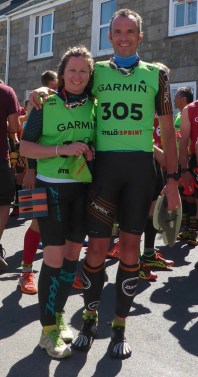
A very civilised local race starting at 6:15 on a Saturday evening. Rachel and I arrived at about 5pm to register and catch up with friends that had also entered. Like most swim runs this had minimal rules with you allowed to use pretty much anything and there was a little transition area so you could leave stuff there when the run or swim was circular.
 SHORT REPORT
2:34:56 – 6th overall, 4th mixed pair
(3.2k swim, 11.6k run) Continue reading

(29.5km run, 8km swim across 8 runs and 7 swims)
SHORT REPORT
5:47:18 18th overall, 12th Male pair Continue reading
SHORT REPORT
3:29:15 – 850th AG / 6140 overall !! Continue reading
That was my 34th Ironman finish and it feels that I know less about being well prepared for an Ironman than I did back in my early days. Even things like race nutrition are more back up in the air than they were when i started. I wonder whether I now over think things. Back then I didn’t know anyone else doing Ironman, didn’t read anything about training. I just did what felt right. I didn’t periodise, didn’t particularly taper I just did pretty much as much training as I could day in day out, week in week out. I was also younger. Continue reading
SHORT REPORT
0:53:12 - Swim
0:03:53 - T1
5:18:47 - Bike
0:03:46 - T2
4:12:28 - Run
10:32:96 - TOTAL - 36th M45-49, 287th Overall
Race Preview
Race Review Continue reading
Race Report
Race Review
It’s been a while since I’ve felt this excited leading in to a race. Trying to be careful though as two years a go I was feeling pretty confident and I had probably my most disappointing Ironman race ever.
Whats different this time ? Continue reading
I’ve started making my own low carb energy bar which I use for snacks and have started to do the bike leg of an Ironman with it. I’m still messing around with the mix so this is the latest version. Whats nice is you can tweak this easily to adjust the macro ingredient proportions.
The basic idea is from Phil Maffetone’s “Phil Bar”. I had to adjust this to remove the powdered egg white. I’ve then adjusted the nuts etc…
Ingredients:
 The percentages don’t add up – the numbers are based on whats on the packet – I reckon the discrepancy is fibre but I’ve not had the time to reconcile it. The numbers are close enough – this is high fat low carb.
Method:
Put all the ingredients in a food processor and blast them till all nicely blended. Then add add a small amount of warm water to get the mix to combine. It shouldn’t be too moist just enough to form bars.
I then do one of two things:
Hope you enjoy them.
Plans:
Based on a talk given at Giant / Blueseventy Event In London on 2nd Feb 2017
Video of talk can be found here.
Before getting into any specific sessions we should start with the fundamentals – whatever level of swimmer you are, whatever you goals, THE most important aspect of any swim session is… Turning up! No matter how good the session is if you don’t turn up and swim they are no use. This means the coach/self-coached athletes’ priority is to make swimming enjoyable enough that you actually want to show up to the pool. This might mean arranging to swim with a friend, or even better join a squad. If using toys gets you swimming then use them. Put on the core shorts, the pull buoy, paddles, snorkel. No matter what the best swim coaches might be saying about the use of swim aids this season; Swimming with these is better than not swimming.
Typically people swim better and work harder when training in a group. This means it’s probably better to swim in a group and compromise the specific session that might be have been set just for you, and do what the group is doing. Specificity is good, yes – but variety is also and keeping things fresh and interesting could be crucial.
Group or squad swims are even better if there is a coach poolside. Technique improves over the long haul, with regular reminders of the things you’re trying to address in your technique. Technical issues are not typically resolved in an occasional one-to-one session, instead it’s those few second comment’s made a few times each session, several times each week for weeks and months and years.
so – swim regularly, keep the sessions interesting and enjoyable, swim in a coached session. These are great starters for making improvements in you swimming.
I still don’t want to discuss specific sessions, as there are some ground rules that you should apply to every session to get the most out of it.
So… now, finally on to some session specifics:
When designing swim session for triathletes, it’s important to remember the nature of the race we’re doing. In our case, the swim is at the start of a much longer event and is normally in open water – where you’re only sense of pace will be by perceived effort level. To this end we’re looking to build ‘sub max’ swim pace and a good sense of pacing. We’re also looking for efficiency so that we can swim the distance without expending too much energy. It’s also the only of our 3 race disciplines where it’s realistic to swim race distance virtually every session. Doing this will help no-end with your race performance.
Here are three types of sets that I incorporate in to the sessions I give:
BUILD SETS
These are sets of repeats where you build the pace in subsequent efforts. It’s typical for even experienced swimmers to go too fast at the start. It’s a great way to get a feel for how easy you have to feel your going when you’re fresh to be swimming at the right pace. Examples of this sort of set are:
12 x 100 build each 3 – this means you do 100 easy / steady, then the 2nd one a bit faster and the 3rd one faster still. Repeat that cycle 4 times to get 12 reps.
Another example is:
4 x 25 build 1-4
4 x 50 build 1-4
4 x 100 build 1-4
This gives a nice progression from build pace over a single length which is typically easier to achieve and then increasing the distance. As your pace judgement improves you should be able to do a series of 400s with each getting a little faster.
RACE PACE SETS ON SHORT REST
These give you a great sense of the pace you plan to swim at. They are done with short rest – only 5-10s. The rest isn’t really for recovery (you shouldn’t need it for your race pace) but more so you can check your pacing. So say your target is 30 minutes for 1.5k (i.e. 2 mins per 100) here are a couple of sessions
15 x 100 on 2:10 holding 2:00 per 100.
A progression from this which puts you under a little more pressure is
15 x 100 done cycling through (2 on 2:10 and 1 on 2:05)
8 x 50 on 1:10 holding 1:00 per 50
4 x 100 on 2:10 holding 2:00 per 100
2 x 200 on 4:10 holding 4:00 per 100
400 aiming for 8 mins
This progression uses the shorter reps to get you dialled in to the pace and then you try and hit a final 400 at the pace.
INTERVALS ALTERNATED WITH PADDLES
I love these sessions as they build strength and muscular endurance which will translate in to efficiency. The idea is to do some fun harder intervals interspersed with paddle work. The paddle work is focussed on maintaining stroke length.
A couple of examples are [using 30 min 1.5k swimmer as an example of repeat times]:
3 x [ 4 x 100 build 1-4 on 2:15, 200 pull with paddles on 5:00]
3 x [4 x 50 FAST on 1:30, 400 pull with paddles on 9:00]
** Explanation of swim sets. 8 x 50 on 1:10 means that each 50 starts 1:10 after the previous one. So if you swim a 50 in 55s you will get 15s rest before starting the next one. If you take 1:05 you’ll only get 5s rest.
Tags: Swim
Please enable JavaScript to view the comments powered by Disqus. blog comments powered by Disqus
© 2002 – 2015 Steven Thomas Lord Contact Me
 Race
Race  Steven Lords Website