The Games We Play

Last month I had a great week in La Playitas training with old friends and new. One of the new friends had only taken up cycling in the past year but he was strong. He didn’t know his own strength as he dropped everyone on any reasonable pinch. On the bigger climbs though he didn’t have the stamina. On one particular occasion he’d been encouraged by everyone else to stick with me on one of the longer climbs. We were riding side by side, chatting but keeping a decent pace and pulling away from the group. At that point in my mind I’d decided I ride friendly all the way to the top, it would be a good chance to chat.

About halfway up we rounded this bend and could see the top.  He’d clearly not been expecting it to be so far and commented on the distance with some words to the effect he didn’t think he could hold the pace. Something was triggered in my mind. Without a conscious thought I was off, upped the pace, didn’t look back (that shows weakness), after a corner I’d push even harder so when he rounded it he’d be even more demoralised. I don’t think he even put up a fight. It was a shallow victory but it made me laugh how these stupid little games are played, how I couldn’t help myself. Like when you work your butt off to catch some unknown rider ahead on a climb, steel yourself for a breezy hello as you pass and then curse yourself that you now can’t ease up for fear of the shame of being re-passed. It’s part of the fun of training with groups. None of these little races are serious, in fact half the time (and half the fun) is that half the people don’t even know it was a race till after. In the latter half of the ride the group discussed this topic and my new friend started to learn this game that cyclists play.

I’ve come a cropper doing this. Last July I was staying at Pyrenees Multisport and tagged along on a long ride with a group also staying there. I didn’t know any of them but right at the start of the first climb, Le Col de Mente, I set off like it was a 5-minute climb. This is my usual tactic if I’ve decided it’s a race, used many times on Epic Camp, go so hard at the start that most just give up. No one came with me but 5 minutes up Nathan had cruised back up to me and was sat on my wheel. I should have twigged at that point. Then after another 15 minutes or so he went by and off in to the distance. He was so much better than me. I’d been at my limit and he was just sat there on my wheel, chatting. I smiled; it’s nice to have it served right back to you like that sometimes. Over the coming days I got to know him better, a very talented athlete who ended the camp by annihilating the Col Des Ares TT record.

Back to La Playitas. Mid week we headed to the lighthouse to do some repeats and see the sunrise. We planned to do three repeats each getting quicker. My running was going well and I was determined to nail the final repeat. I was running with two others and on the second repeat I kept dropping off the pace and apparently working hard to get back on. Come the last repeat Robin went off very quick and Roger commented it was too quick. That was enough for me and I pushed on repeating in my head “you used to be a fell runner, you were superb at running uphill”. I got second to the top and was quick enough that to this day I reckon Jo still thinks Roger and I are making it up. It certainly created some banter during the day. Though never agreed it was clear to all three of us knew that it was a race. It won’t be so easy next year.

A year a go I was swim training with Rachel. She wasn’t swimming her best and we were doing some long repeats. Come the last one I sensed I might manage to lap her. I didn’t say anything, it would be easier if only I knew it was a race. I got nowhere near. She knew the unwritten rule: if there’s a chance the leader could catch the back marker then the final rep is an outright race. No way would she let me win that and she found a big final effort. This rule is learnt early. I currently train with some very talented youngsters and come that last rep if they’re getting even the slightest sniff of weakness there’s a flat out race to lap me. With these guys, on average, I lose.

Our third EverydayTraining camp is about start and we try to incorporate this fun side of competition by including several races. They add to the camp experience but it’s still the anonymous racing that can prove most fun and if only a subset even realise it’s a race beforehand even better.
Posted in Triathlete Europe | Tagged | Leave a comment

The Budget – Housing

Yesterdays budget yet again demonstrated that the government really has little idea of what is causing our problems or any ideas of what to do about it. With £1 trillion in debt we get a budget with headlines of 1p off beer and help to the housing market. Of course I know that with the current monetary system it is impossible to pay off the debt without reducing the money supply so without fundamental change any attempt to pay of the debt will be flawed.

That said surely it must appear rather strange that on the one hand the government is saying they’re trying to pay down the national debt but on the other they are putting in place policies to encourage individuals to take on more debt. So the problem to the debt problem is more debt … funnily enough in the current paradigm that may well be true.

I would like to focus on Georges housing policies and make a few points

1. Firstly I do not understand the focus on getting the housing market moving. This is a non productive part of the economy. Just think about it – under this paradigm it’s better for everyone to move house than for everyone to stay put. I would argue the former is wasteful and stressful whereas the latter would be ideal. Encouraging yet more money creation via the housing market is only going to fuel house price inflation further. This leads to my second point

2. The policies are focussed on new build homes. This is, presumably, as it will place money with home builders and create jobs. This raises so many questions

  • this is not a way to a sustainably economy. Surely it is clear that we can’t just keep building more and more houses or are we proposing knocking down old ones to build new. Completely nuts
  • building new houses suggests we don’t have enough. Again the flawed view that house prices are increasing due to supply and demand (i.e. too few houses) rather than because something like 90% of all bank lending (i.e. new money creation) has been pumped in to housing.  If there was this level of shortage surely we’d see millions sleeping on the streets.

3. The government plans to extend a loan of 20% to help those that can “afford” the repayments but don’t have the deposit to get a home. So, the government is encouraging people who can’t afford a home (if they don’t have the deposit by definition they can’t afford it) to take on a massive debt at a time of historically low interest rates. Sounds to me like they’re aiming to get people bankrupt in a few years

4. Even worse the government will then act as guarantor for these loans. Did this government mis the sub-prime crisis. This is what is called “Moral Hazard” – if the banks know the government will cough up why should they worry about the ability of the borrower to repay. This merely encourages bad lending and yet again puts the banks in a position of gaining on the upside but not losing on the down. A very similar moral hazard exists due to the government insuring £85,000 of deposits since it means that depositors feel no inclination to take an interest in the health and lending habits of the banks. It also means the banks know they will be bailed out as it almost certainly be cheaper to keep them afloat than pay out on this insurance. This sort of government  guarantee should be stopped.

It’s important to appreciate that money is created out of debt. So for the national debt to be reduced without reducing the money supply then some new money needs to be created. Perhaps this is why the government is encouraging more personal debt. The system needs to change.

I focussed on housing here but there are other pieces that caught my attention – scrapping fuel duty and a new tax regime to promote early investment in shale gas. Both these are terrible for the environment. It just confirms that when economic conditions get tough one of the first things to sacrifice is the stuff aimed at saving out planet. This is the ultimate in short-termism and the most worrying aspect given how rocky I reckon the economy will be during the coming decades

Posted in Collapse, Critical Thinking, Money | Leave a comment

Should It Be Comfortable ?

As I right this, the hot topic is Lance’s confession on Oprah. I’ve steadfastly not watched it thinking perhaps the best approach would be if the whole world chose to ignore him. Not give him a platform. So I decided not to mention him in my column –big fail there.

With the weather the way it has been I’ve had quite a focus on my swimming. I’m lucky to train with some very talented juniors who really push (lap) me. This morning as I approached the last 100 of a hard 400 repeat my arms start to scream at me to sacrifice technique in order to reduce the discomfort. I know to ignore this. This is when it counts, this is when good technique gets really engrained. When it starts to hurt you need to double your focus on the right movements.

It’s part of our sport to feel uncomfortable a lot of the time, which means there’s an important distinction to learn – good hurt, ache, pain, discomfort (chose your word) as opposed to the bad sort. I’m not sure anyone will ever know 100% of the time but time training and experimenting will help you decide.

With swimming being perhaps the least natural activity it uses muscles that are seldom used in that manner in normal life. It means that almost certainly if you’re doing it right you’re going to get muscle aches. Our natural reaction is to adjust what we do to remove the ache which means in swimming you need to concentrate since if you don’t there’ll be a tendency to adjust your movements (ie perform bad technique) to minimise the discomfort. So when you feel this good ache of proper technique focus to keep your stroke perfect as the ache builds. With swimming the volume most triathletes do I can’t imagine there’ll be many occasions of getting bad aches.

Cycling is quite the opposite of swimming and I don’t just mean that it’s on land and it uses a machine. With cycling you are in a pretty fixed position – feet attached to pedals, hands on bars in only a few different ways and bum on saddle or standing. With swimming there is nothing fixed, you have to provide the tension to work against. It means with cycling there are far fewer degrees of freedom and provided you have a good fit you should hopefully be able to ride pretty much injury free. So for me aches on the bike tend to be viewed as good.

Last summer I tried out 165mm cranks. This was a big change from the 175mm I had on all my other bikes. They felt comfortable. I persisted but over time I became less convinced. Was this good comfort or bad comfort? It felt like I struggled on hills and couldn’t put the power down and soon switched back. This evening I did my third bike test of the reason. I do a 1 minute best effort, 5 minutes easy then 10 minute best effort. The one minute definitely produces good pain and the 10 minutes good severe discomfort.

As for running, we’re halfway between swimming and running in that you propel yourself from a fixed point (the ground) but there are lots of degrees of freedom. This together with impact makes it the sport most likely to give you the bad sort of discomfort.

After a bout of illness in Autumn I returned to my running stupidly motivated and during a big hill repeat session convinced myself that the discomfort (pain really) in the side of my knee was the good sort. It wasn’t, I should have stopped. It took weeks of reduced running and biking to sort it. This is the sport where I’ve historically misjudged discomfort most.

After Kona 2007 I started to get discomfort in the ball of my foot. I discounted it as hot feet and over the course of 2008 it continued but didn’t seem to affect me at all (as long as I ignored it). This convinced me it was good discomfort. March 2009 the discomfort disappeared when I snapped my FHL Tendon. The specialist was stunned that I’d put up with the pain but when it slowly builds like that you just keep writing it off.

Since returning I’ve been super sensitive about running discomfort and apart from the blip this autumn I’ve erred on the side of caution. I would go as far to say that I’m only running if there’s absolutely no discomfort and that I’m using this as an excuse not to run. My run performances have suffered dramatically because of it.

So this year I’m trying to rebuild my judgement of good run discomfort. I’m slowly going to build, put up with some aches and see how I go.

Posted in Triathlete Europe | Leave a comment

Racing Unfit

In the run up to Ironman Western Australia it became a running joke with the friends I was staying with that whenever I accepted a beer they would comment “that’s another 5 minutes on to your time”. They were enjoying my much more relaxed approach on my third visit to Busselton, in fact, I had a beer every night I was there.

That’s what comes from changing goals from performance based to enjoyment based.

It took a while to reconcile myself to heading halfway round the world to take part in a race that I had no hope of achieving the personal best I’d set as my goal when I’d entered a year before. If the race had been in the UK I would definitely have pulled out but this was a trip to the other side of the world with my mum so she could visit her friends. The aim was to enjoy the whole trip.

Race morning was a pleasure, as I felt so relaxed. Not my normal arrival 5 minutes after transition opens just in case I have a puncture (for a third time!). This time I was nearly an hour later. The usual two-minute job at my bike (no puncture) and I went to relax.

To enjoy this race I had to race to my fitness. It was going to get messy but the longer I delayed it the better. I started the swim just fast enough to stay out of trouble and then swam on my own as no packs were visible in the rough water. I hit the second half the swim and rather than having to tough it out I found an easy change of gear. It was fun.

I set off very conservatively on the bike but by 30km I started feeling very low and thought that this was going to get very messy very early. It lasted till I got to the second lap and I started to pass people. This prompted me to look at my power and see the average was increasing. My mood changed instantly, I felt great. It slowly dawned on me that I’d probably not been low at all, I had just not been thinking, I’d not used my intelligence to assess how I was. I also realised it was not the first time it’s happened to me in Ironman. I decided to keep a cap on efforts till the final lap and then hit it (it would be fun) but then passing a group at about 110km I sped up and didn’t slow down. I was hitting watts that would have been excessive when I was fit but I kept going. At the turnaround when the expected tail wind failed to materialise I had a little implosion. I’d managed to let my brain switch off AGAIN mere hours after realising that’s what was happening.

I made it back and headed off on the run. I kept Helens words in my head “you’ve perfected the hunters trot, now you need speed”. Hunters trot is all I needed now. Those Palaeolithic men could have run for days like this. My ambitious 4:50 kilometres ended after just two. After 20km it was hurting but it was still fun. I’d passed the 30km market before I hit DEFCON 1. It wasn’t pretty and I’m not convinced it was fun but I was close enough to be certain of getting my medal and t-shirt.

It’s always a buzz to cross the line. It’s just different when you’re race has not been as you’d have hoped. Keeping pushing when it’s getting tough is really the same whether it’s the leader holding 4:15 km when his body is screaming for 5:00 or whether it’s me on a day like today running when my body was screaming walk and at times walking when my body was screaming stop.

I came away very satisfied with this race. Not my fastest but I felt that I could not have gone faster on the day. I’d also managed to hit a small milestone of 25 Ironman finishes. A lot was learnt from this race but two things stand out:

  1. You need to keep your brain switched on no matter how you’re feeling. In Ironman being able to always maintain rational thought is a big asset.
  2. You cannot hide from a lack of run training. Try to remember this at least 6 months before the race not at kilometre 20 of the run.
Posted in Triathlete Europe | Leave a comment

Money Creation Alternatives

My previous posts highlighted how over 96% of our money is created as debt when private banks make loans. Since these loans incur interest the only way they can be paid off is if the money supply increases and thus more debt has to taken out. This means our economy is hardwired to require endless growth. Endless growth is infinite growth and it just cannot go on forever.

This post is going to look at an alternative approach.

Firstly lets just look more closely at what happens when our government borrows money. To do this the government auctions government bonds. There’s a period where banks bid for this bonds based on yield – this process establishes the interest rate the bonds are issued at. [so not only does the government go to the banks for money but it lets them decide how much profit they should make!]

When the bonds are sold the major buyers are pension funds and banks. If pension funds buy the bonds then it just recycles money that has already been leant in to existence. If banks buy these bonds they merely make an entry in their accounts – on the one side they have the government bonds and on the other they create a deposit for the government. This means money is created. The banks do not remove deposits from anyone else’s account to create these deposit – they create brand new electronic money.

So government borrowing increases the money supply.

It does this by getting the banks to make an entry in their accounts and then the government (i.e. we the taxpayer) pays interest on this to the banks. This probably makes your mind recoil since the cost of making those entries in a computer system are negligible yet we end up paying the banks interest annually for the privilege.

So now think about what happens if the government actually pays off this debt. They take electronic money and pay it back to the banks. The banks reverse the original entries (they reduce the governments deposit and remove the bond) and money is removed from circulation. Our economy needs this increasing money supply due to our need for growth. If the money supply is reduced we will get deflation (I plan to blog about inflation and deflation in a later post). Thus not only do we have the issue that by definition there is not enough money to pay off all the debt but also that if the government does make major inroads into paying it off there will be reduced money supply which will lead to deflation.

How could this be different ? The first thing is that money should not be issued as debt. It seems utterly insane that we (through our government) leave the banks in this privileged position of making the accounting entries to create the electronic money. By doing it this way we need to pay interest on it. Why doesn’t the government itself just make these entries itself and not create the debt and not pay interest ? Rather than the Bank Of England trying to control inflation via interest rates (which in theory either encourages banks to lend more or less thus changing the money supply) they instead could decide how much money should be created. This could then be either spent in to circulation, given through tax cuts or even through a national dividend ( see Major Douglas who proposed this after The First World War ).  [The recent quantitive easing programme “in theory” was the government creating money but they merely injected it in to the financial sector rather than the real economy. If you want to realise what a MASSIVE missed opportunity this was then read this.]

For people brought up with this current paradigm (i.e. all of us) it’s incredibly difficult to imagine another way but please do. Under these circumstances there would be no government debt. Instead of huge amounts of money being brought in to existence through mortgages (thus inflating house prices) it could have been spent on productive capital leaving house prices affordably and investing in productive assets that would provide jobs and real wealth to the country.

This is not without precedent:

  • it could be argued that the spirit of The Bank Charter Act 1844 was that the creation of all money should be in the hands of the government. So like notes and coins the government would issue electronic money ‘for profit’. Even after the act it didn’t stop the creation of deposits through lending since cheques still allow payments to be made without conversion to notes or coins
  • section 8 of the US Constitution  states that the US Congress has the power to coin money. Though that doesn’t exclude others doing so it does make you wonder whether the intention was the the US congress should be the only body creating money
  • Henry I started the use of Tally Sticks which effectively was money issued by the crown free of private bank debt
  • During the American Civil war Abraham Lincoln issued “Greenbacks” free of debt after the bankers asked for huge rates of interest to lend.

It’s interesting to note the following is attributed to Abraham Lincoln – it’s difficult to verify whether he definitely wrote this but it appears to state what he was putting in place with the Greenbacks. If this had become the US monetary policy it would have completely changed the way money was created world wide, the power of the banks and we’d be living in quite a different world right now. Lincoln was assassinated shortly after this:

Money is the creature of law, and the creation of the original issue of money should be maintained as the exclusive monopoly of national government. Money possesses no value to the state other than that given to it by circulation.

Capital has its proper place and is entitled to every protection. The wages of men should be recognised in the structure of and in the social order as more important than the wages of money.

No duty is more imperative for the government than the duty it owes the people to furnish them with a sound and uniform currency, and of regulating the circulation of the medium of exchange so that labour will be protected from a vicious currency, and commerce will be facilitated by cheap and safe exchanges.

The available supply of gold and silver being wholly inadequate to permit the issuance of coins of intrinsic value or paper currency convertible into coin in the volume required to serve the needs of the People, some other basis for the issue of currency must be developed, and some means other than that of convertibility into coin must be developed to prevent undue fluctuation in the value of paper currency or any other substitute for money of intrinsic value that may come into use.

The monetary needs of increasing numbers of people advancing towards higher standards of living can and should be met by the government. Such needs can be met by the issue of national currency and credit through the operation of a national banking system. The circulation of a medium of exchange issued and backed by the government can be properly regulated and redundancy of issue avoided by withdrawing from circulation such amounts as may be necessary by taxation, re-deposit and otherwise. Government has the power to regulate the currency and credit of the nation.

Government should stand behind its currency and credit and the bank deposits of the nation. No individual should suffer a loss of money through depreciation or inflated currency or Bank bankruptcy.

Government, possessing the power to create and issue currency and credit as money and enjoying the right to withdraw both currency and credit from circulation by taxation and otherwise, need not and should not borrow capital at interest as a means of financing government work and public enterprise. The government should create, issue and circulate all the currency and credit needed to satisfy the spending power of the government and the buying power of consumers. The privilege of creating and issuing money is not only the supreme prerogative of government, but it is the government’s greatest creative opportunity.

By the adoption of these principles, the long-felt want for a uniform medium will be satisfied. The taxpayers will be saved immense sums of interest, discounts, and exchanges. The financing of all public enterprises, the maintenance of stable government and ordered progress, and the conduct of the Treasury will become matters of practical administration. The people can and will be furnished with a currency as safe as their own government. Money will cease to be the master and become the servant of humanity. Democracy will rise superior to the money power.

Abraham Lincoln, Senate document 23, Page 91. 1865.

There are organisations trying to push our government to make changes such as these:

The Monetary Reform Party

Positive Money Org – they have even draft the Bill that would need to be passed in parliament to move to this.

I’ll end with a quote from another US President – Thomas Jefferson

And I sincerely believe, with you, that banking establishments are more dangerous than standing armies; and that the principle of spending money to be paid by posterity, under the name of funding, is but swindling futurity on a large scale.

from a letter to John Taylor (see here, bottom pg 298)

Posted in Money | Tagged , | Leave a comment

Money Creation – A Historical Perspective

A recap on the last post. Over 95% of our money (all the electronic money) is created by private banks (for profit) through the creation of loans.

The Reserve Ratio was abandoned (per the Bank Of England website here – look under “Band 1 dealing rates”)  and replaced by the Cash Ratio (see here ) which hardly seems onerous requiring 0.11% of deposits (less than 2 years) to be held at the Bank Of England.

Ever hear the phrase “license to print money”.

Ever wondered why house prices went through the roof completely out of correlation with any change in population despite there being ongoing house building. Printing excessive money creates inflation. In this case creating excess electronic money and pumping it in to housing created the close to hyper inflation we’ve seen numerous times since the early 80s.

How on earth did we as a country allow the creation of money to be in the hands of private banks ? A little historic perspective may help.

There was a time when money was gold and silver coins. They were good for money since they were in limited supply. You couldn’t just go creating them and they were difficult to forge. Coins would be issued by the crown and if there was a need for increased money supply they could recall the coins and re-mint them with less gold or silver content. There were issues with using gold but thats not for this post.

Goldsmiths fell in to the role of securely storing peoples money and issuing notes as promises to redeem it on presentation of the notes. Soon people found that it was more convenient to carry the notes rather than the coins and they became a form of money. The Goldsmiths / banks started to notice that only a certain proportion of notes were ever presented at one time so they could issue more notes than they had gold. Just like in todays electronic world they could make a loan merely by making an entry in their accounts and printing the notes. Provided they kept sufficient reserves of gold for any notes that were redeemed they’d be OK.

There were problems. If they got their calculations wrong they could run out of gold. At which point they would call in the loans which would have to be paid in gold. Runs on banks were common, just a rumour that they would run out of gold could result in people demanding their gold for the notes and a self fulfilling prophecy would ensue. Just think now what such a bank run would mean. When you have an account with a bank you think of it as offering two things – one you can convert it to physical money and two you can make electronic payments with it. If you felt a bank was going bust you would either transfer you money to another bank or go get the cash. Given that about 4% of money is cash and 96% is electronic if all those 96% holders of electronic money try and convert it to cash we’ve got real problems !

It was in the interests of the banks / goldsmiths for the paper notes they were issuing to be more widely accepted. To be trusted as having value in and of themselves. As people became more comfortable that this piece of paper could be exchanged for goods at some future date fewer and fewer people ever found the need to redeem for gold. This meant that the reserve of gold they kept could be less thus allowing more loans to be made for profit.

Remind you of anything ? Wonder why banks make it so easy for electronic transactions to take place ? Free internet banking ? free debit cards. All this push for the cash-less society. The less we demand converting our electronic money to coins and notes the lower the reserve ratio the banks can employ and the more loans they can make. Remember there is no longer a legal reserve ratio the banks just decide what they need themselves.

Back to history.

Allowing private banks to issue their own notes meant they controlled the money supply. It’s effect was for periods of high inflation (when they issued lots) followed be deflationary periods. In 1844 the government of Robert Peel passed the Bank Charter Act – this stopped banks issuing new bank notes and left the issuing of new notes in the hands of the Bank Of England and all must be 100% backed by gold or up to £14 million of government debt.

Yes, back in 1844 the government had the guts to remove the ability of banks to print there own notes. I’m sure it could be argued that the spirit of the act was that private banks should not be able to create money BUT it  is all to do with notes. They could never have foresaw the electronic age, computers and the like. The idea of electronic money wouldn’t have had a basis to be even imagined.

So now we’re back in the equivalent position. The private banks create, effectively, our whole money supply. They increase or decrease it’s supply for their own benefit resulting in cycles of boom and bust. More or less all money is issued as debt plus interest which means for it to be paid off yet more debt must be taken out. Under such an axiom it is impossible for us to become debt free without us removing 96% of the money supply (in fact, given we’d have to pay back 96% + Interest it’s probably impossible to pay it back FULL STOP). Look at government debt, if they paid it off it would require removing half the money supply which would clearly result in a massive depression.

For me it is almost beyond belief that politicians have such a misunderstanding about all this. When they talk about the need for austerity to reduce the deficit and pay of the debt they clearly have no idea. Then in the next breath they say we need a return to growth. Off the back of this you wonder whether they should be allowed to make any decisions.

Luckily there are groups trying to get this sorted. Take a look at:

Positive Money

The Monetary Reform Part

Shortly I shall blog about the alternative.

Posted in Money | Tagged | Leave a comment

How Is Money Created ?

Do you ever think about where money comes from ? It’s not like people growing stuff, making stuff and selling it somehow produces money. Money is merely a method to allow us to facilitate trade. It needs to be created and put in to circulation. When it comes to hard cash it’s simple. The Royal Mint produces the stuff and sells it to the banks on behalf of the government. The money earned goes in to government coffers.

Ever wondered where the money comes from when you get a mortgage or borrow for a car ? Perhaps you believe that the money you are borrowing is someone else’s money who doesn’t need it right now.

According to CreditAction UK personal debt stands as £1,421,000,000,000. yes thats £1.421 TRILLION but I like to write it out fully so it hits home the completely insane number. Really do you think someone has got money sitting in a deposit account to that amount ?  Ah but there’s fractional reserve banking you say. Yes there is. Banks realise that at any one time only a small amount of money that is deposited will ever be demanded so they only need to hold back a certain percentage of deposits and can lend out the rest. Since the money thats leant is spent and will ultimately end up as a deposit to which the same rule applies, you can lend a much higher percentage than the amount deposited.

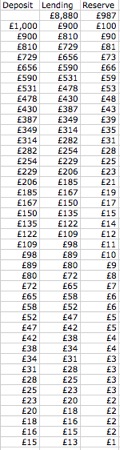
lending.jpgThis chart illustrates what happens to a £1,000 deposit with a 10% reserve requirement. After 41 steps we’ve got lending of £8,880 and reserves of £987 sitting as deposits. The missing £13 is what was lent out at the last step which has not yet been deposited.
The formula for this is:

£Total Lending = (£Deposit – (Reserve% x £Deposit)) / Reserve%

Lets look at some figures:

UK National Debt: £1,278,200,000,000  (see here)

UK Personal Debt: £1,421,000,000,000 (as per above)

Total: £2,6999,200,000,000

Here’s the levels of deposits in £sterling required to support that given the above model:

At a 10% reserve requirement a mere £299,911,111,111 of deposits (yes 300 BILLION)

At a 3% reserve requirement it’s down to £83,480,412,371 of deposits

Even at 3% do you imagine that there are people out there that together have got £83 billion sitting in savings accounts.

If you’re confused don’t worry, I reckon even most economic graduates don’t understand how this really works. I did economics a-level and worked in Interest Rates in a bank for over 15 years and it wasn’t till I left the bank and studied it independently that I figured it out. So please stick with this as it’s important people understand.

Here’s what actually happens when you get a loan from the bank. Once they agree your loan they make a double entry in their accounts (yes I trained as a chartered accountant before going a bank). The following:

  1. In you nominated account they add the money you’ve borrowed. This is money they owe you (i.e. you can spend it)
  2. They create an asset on their balance sheet the money you owe them.

Thats it !! You head off and spend your money and they left with this asset. YES they have created money out of thin air. There is no longer a formal reserve percentage in the UK. There are some broad brush capital requirements for banks but when they lend they create money.

So how much money are the banks creating ? It’d be nice to know as it sounds like a bit of a money spinner – you create something more or less out of nothing (you need some book keeping) and then charge interest on it. Before I get on to this it’s worth while pointing out that the only reason this works, like any form of money, is because we all completely trust that payments can be made electronically and that if needs be we can convert this electronic money in to cash. More on this later.

Per the Bank of England site (look here )

They have broad money (~ cash + all deposit accounts) at £1,643,600,000,000

Narrow money (cash + BofE reserves) at £63,362,000,000 -> This is money the government creates

The narrow money is 3.86% of the total which means the private banks create over 94% of our money supply.

This should shock you. It’s important to pause here and just think of the implications.

  • This means that 94% of all money is created from debt. i.e. when the money is created an equivalent amount of debt is create
  • This means if you have £10,000 in a deposit account someone somewhere has nearly that amount of debt
  • The banks are deciding where 94% of money created is allocated.
  • This means if we pay off any debt the money disappears.

Read the last one again. So when politicians talk about paying off the debt it appears to me they really haven’t got a clue. If we managed to do that we would massively reduce the money supply which would bring about a massive depression.

The problem is it’s worse than this.

So the majority of our money is created by debt. Now when you borrow you have to pay back plus interest. Where is that interest going to come from ? Given all the cash is only 4% of the money supply there’s no way that money is paying back your interest. The only way the debt can be paid back is by more money being created. This means more debt has to be taken out to pay the original money back. I hope you see this is never ending. It’s why we HAVE TO HAVE GROWTH for our economic model to work. It’s also why the majority of the population is currently doomed to ever more debt. The knock on effect of this is something for another post.

The key thing to realise is that under this model it is IMPOSSIBLE to pay off the debt.

The second implication of this is that private banks are deciding where most money is allocated. Lets look at it from a banks point of view – where would you tend to lend ?

  1. To productive businesses where the risk is if they fail you get nothing back; OR
  2. To people buying houses where if they can’t pay you get most (possible all) your money back because of the asset

I’m hoping you see that B is going to be the preference.

I recently read a book about the Wiemar Republic and hyper inflation. At the time the government saw inflation and felt they had to keep printing money to allow people to buy stuff. It’s only after the fact people realised that it was the excessive printing of money that created the hyper inflation.

So with banks creating so much money why haven’t we had hyper inflation ? WE HAVE.  Look at house prices. The inflation has come where they’ve allocated the money – thats been house prices and various speculative bubbles – think dot.com bubble, think sub prime bubble.

Given the key role private banks are playing in our money supply you can see why they are ‘Too Big To Fail’. The government puts in place the Financial Services Compensation Scheme to protect your deposits up to £85,000. This is very re-assuring for us as individuals but really it’s a pretty stupid thing to put in place. Basically the government is taking a huge chunk of risk from the banks. Why not take more risks when you know the government will pay out like this. Also, they know they’re too big to fail so why not risk a bit more.

For me the solution to the banking problem and the solution to the massive debt problem are one and the same. This power to create money has to be taken away from the banks and put in more responsible hands. There is precedent for this. This will be the topic for a future post.

Posted in Critical Thinking, Money | Tagged , | Leave a comment

Eddington Review 2012

Edd2012

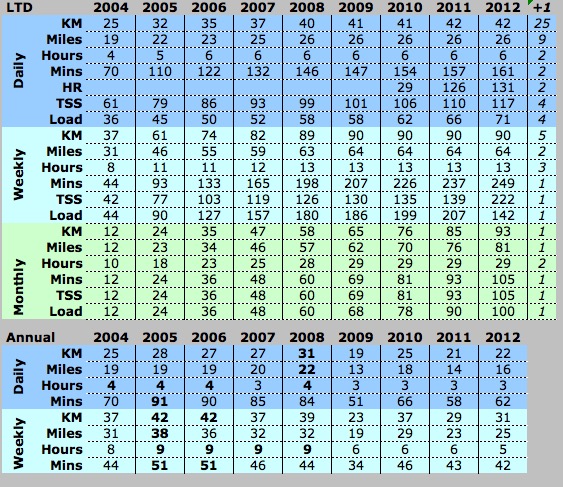
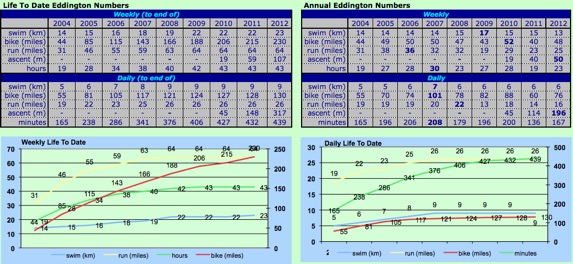
The picture shows a history of the progression of a selection of my Eddington Numbers. The graph is trying to visualise whether the numbers are approaching a limit. It seems pretty clear that my daily swim KM number of 9 is not going to advance much if at all and my run miles number of 26 will take some cracking.

These numbers are not a training aid, though sometimes they help get me out the door. The are just fun (for me). I love chasing them. I find the fact the more you chase them the harder they get quite fascinating. This year I started out with a few Eddington Goals. In no particular order

Hit 130 Bike miles. This I did but now progression is getting really hard fought with it require 10 rides of 131 miles or more to hit 131. To prevent the ones after that getting even hard some of these 10 rides need to be a lot more.

The other two I failed on. Firstly hitting 120km daily bike KMs for the year which would have been a best annual performance. I decided on KM as my mile record of 101 for the year seems still unattainable. I managed 98 KM and will be chasing that again this year. The other one was 200 daily minutes but I only got to 167. This year lets try for 210 which will be a record. That requires four 3.5hr days for most weeks of the year. I felt I was reasonably on track through to Ironman Wales but then the boughts of sickness just knocked me for six. Without them I may have been close enough to these goals for them to get me out the door in the run up to christmas.

SWIM

Edd2012_swim

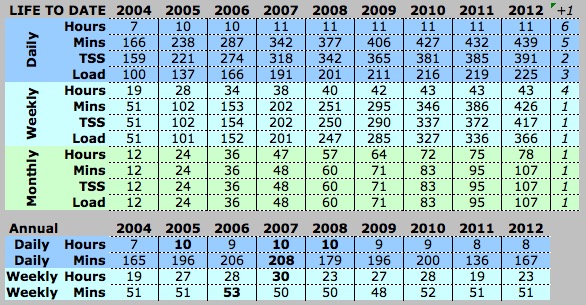
Swimming highlights why Eddington numbers are just fun and provide limited insight in to performance. If you look at my annual figures it would seem in general I am down on previous years. Few hours few miles, less consistency but despite this I am swimming better than I ever have. Two numbers give an insight – the weekly 47 minutes shows that there were only 4 weeks off swimming. Then there’s the daily watts figure, though I’ve only been tracking this for a full two years (so the 2010 figure tells little) it shows that my wattage when training is higher. Though my outright volume is less virtually all my swimming now is in a very good environment resulting in more hard work done.

For next year I would like to see a weekly KM number a bit higher. It always feels that getting to 16 shouldn’t be an issue but it’s not that easy having attained it only once (17 in 2009),

Bike

Edd2012_bike

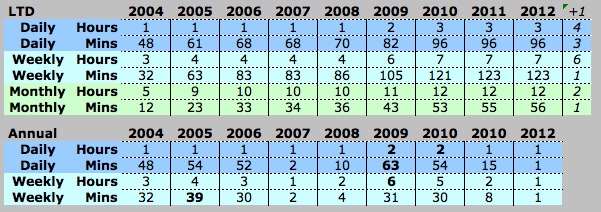
This is where it all began. Eddington devised this number around number of miles ridden in a day and this is the number that I’m most interested in. This year I advance it by two to 130. Every year I’ve moved it forward and will continue to do so as long as I can. This is getting tough now and I must admit to my mind moving to tactics. It means next year I really need to work to put some rides out there but ensure I don’t stretch it to 132 ! Certain other numbers are now starting to get interesting –

Bike Daily KM is 192 – I’d like to see that at 200

Bike Weekly KM (289) and Miles (230) are now getting tougher but getting to 300 and 250 respectively would be nice

Ascent has only been tracked recently and I think there’s a good few years before thats of interest. It’s quite tricky to do a ride round here without getting at least 500m of ascent.

Run

Edd2012_run

I so wanted to move my run weekly miles on but didn’t manage it. I did how ever get closer as finally I did a week of over 64 miles. First time since my surgery and was a really boost. Hoping next year I will get some consistency at that sort of level and see this number finally move on. The daily numbers are tricky as they’ve hit a natural high at marathon distance. I did manage one run over over distance to move it closer but it’s really a multi year task to move it forward at all. I really need to get back in to fell running to have any hope.

Total

Edd2012_total

My daily minutes number is still ahead of weekly minutes but that will probably not last the year. The daily number however is heading the way of my daily bike miles, it probably won’t be long before it’s difficult to move it on. It stands at 439 which means I done 439 days of 7hrs19 or more and I need 5 days of 7hrs20 to move it one. This number is already seeing my tack on the odd KM here and there on the bike just to get an extra few minutes.

Gym

Edd2012_gym

Again for completeness. Not a year for going to gym – going a measly once. At least it was over an hour. Unless my house mate gets me in to doing squats I don’t see me venturing to the gym this year.

Posted in Eddington Review | Tagged , , | Leave a comment

Dealing With Injury

Here in Busselton it’s 35c outside though we’re five days from race day I find myself the least well prepared for any Ironman I’ve done. Over the 10+ years I’ve been competing at Triathlon I would say I’ve been a robust, or perhaps lucky, triathlete. Each race I’ve started I’ve arrived at the start line knowing there’s decent preparation under my belt and my performance will reflect the training I’ve been willing and able to do. Where performances have not been as I would have hoped it can always be explained by lack of preparation which invariably has been due to lack of motivation. In other words, any disappointed was my own fault.

That was until now.

After Ironman Wales I was super motivated. That race gave all the signs that I could be in personal best shape for Ironman Western Australia. I managed my recovery well and quickly. My annual cold struck right on cue at the change of the seasons and lasted, as usual, precisely a week. There followed a couple of weeks great build including my biggest run week in many years, before I got hit by another illness. This lingered on a full two weeks with zeros in my training diary. Then with stupid enthusiasm my first session back was a 2.5hr run hill repeat session (bonkers I know) which resulted in a niggly trigger point that prevented any serious bike and run training right through till now.

So November rather than being my biggest month of the year was the smallest and left me rethinking my goals for the race. I’ve never felt such frustration leading in to a race before and made me empathise with, my fellow columnist, Rachel on getting a chest infection ahead of Kona. For me this was small beans really, it is just a hobby. However, the goal of going to a fast course like Busselton was definitely to get a PB and hopefully have a shot at sub 9 hours.

A change of goal was in order but more immediately was deciding what would motivate me to do the best thing day to day for my performance in Australia. It really brought home that race goals just don’t get me out the door or get me to focus on good choices. It’s just not immediate enough. The best thing I could do towards my race performance, apart from my exercises, was to keep right on top of my diet. Don’t put on weight and keep lean. The race several weeks ahead just wasn’t enough to help me make those good minute-by-minute decisions. Clearly for me it is all about the process. The penny dropped. This is why when I’m training well everything else clicks in to place but when I’m not I make poor choices.

This realisation was almost like a weight removed. Perhaps the race wasn’t as important as I thought it was. Realising the real fun of this whole game comes from the training help me put it in perspective. This meant I should do what was best to recover for the long term rather than to try and eek out Kona qualification at Busselton. I relaxed, pulled out of the latest beer ride, threw myself in to swimming and stopped worrying about how fit I’d be for my race. If I had to miss sessions to get better then so be it.

That has left me wondering what to aim at this coming weekend. My friend, Alex, suggested trying to race to fitness. It sounds great but I’m just not sure how fit I am right now. There is still a chance that I won’t be able to run and I’m ready to pull out of my first race if I feel it’s doing more harm than good. I’m here to enjoy the sun and the good friends I’m staying with. I’ve had a drink (occasionally two) every night so far. I’m enjoying it. I’m training, far harder than you really should this close to a race. I’m also nodding politely every time someone tells me how I may well surprise myself. All the training I’ve done this year and for years before will count for something. For the first time I’ll be fully rested. I smile and give positive mutterings but I don’t believe, they don’t know just how little I’ve done. That said, in my heart there is something that is wondering “perhaps?”

Posted in Injury, Triathlete Europe | Leave a comment

Ironman Western Australia – Analysis

IMWA-RacePrep12

Race Report here

I’m not a believer that you always learn something from a race, good or bad. My experience with Ironman is that I generally get what I deserve. Outside of doing something completely bonkers in execution or a mishap it’s rare that your race will be way off the mark.

This race confirmed the latter BUT this race I definitely learnt a lot about race execution.

The details above give a broad outline of what I managed between completing Ironman Wales and taking part in Ironman Western Australia. I had a decent amount of time and felt I could maintain my bike and really push on with my swim and run. The first bout of illness immediately after the recovery period was not unexpected. It happens so often I didn’t sweat it at all and just pushed back the initial build. This went really well – two weeks of solid biking with a build into a solid week of swim and run. This was followed with an easier week planned to coincide with my nephews and sister visiting.

It then went a little pear shaped. The 6 weeks from then averaged only 12 hours per week of which only 15km a week was running. When I point out the biggest running week was 24km and that was a single run you see that the underlying run average was closer to 10km. Once I got over my illness a mere two weeks of solid swimming got me in to the swimming form of my life. Unfortunately during that period I had a niggly trigger point which was causing such discomfort in my knee I couldn’t lower my weight on my left leg. Biking wasn’t uncomfortable but it clearly made the trigger point worse. I felt in a tricky position – I could push on and get really bike fit but that would increase the chance of just not being able to run. I took a longer term view and did what was required to get better – this meant much reduced riding.

I’ve had comments and encouragement from many quarters suggesting that the years of endurance in my background would stand me in good stead. In terms of completing I’m sure it did. In terms of competing, which was my aim, having 6 weeks out of serious training removes an awful lot of fitness. With biking I had a big base to fall back on which is reflected in the bike split – a respectable 5:12 which is far from the competitive 4:45 and 4:49 I’ve done previously on this course. Running though I had no where near that base. I’ve always felt that I had enough time completely out of running following my foot surgery that I was more or less starting from scratch with that. To give an idea – in the 5 years prior to my foot surgery I ran on average 2,300 miles per year, the four years post it’s been 1,100 miles. I won’t go in to the reasons here, the key point is I don’t have the run miles in my legs.

I will now look at my race execution.

SWIM

I felt very relaxed waiting for the start and when the gun went I didn’t go too hard, did just enough to stay clear of trouble. It was so rough and choppy that finding feet or sitting on feet wasn’t that easy. I quickly decided this was likely a solo swim and just swam it comfortably. After the turnaround I was able to surge by applying more pressure and drop some guys that were annoying me. Though 52:16 is slower than 2 years ago this was a far better swim – it was very little exertion and the conditions were very choppy. I exited the water feeling pretty fresh. Certainly in future races I should keep this in mind – if I’d worked hard I’d be lucky if I was a minute quicker but I’d come out pretty tired.

BIKE

IMWA-Power12

I set off conservatively as I knew I wasn’t in the condition I’ve been in the past. I’d mentally rehearsed not to react to people passing me. This went well for about 30km but then I started to feel very flat and my power dropped. With time to reflect I notice that this happens each time I set off conservatively. It’s as if by not pushing I lose focus and then as my power drops I don’t have the presence of mind to make the connection and I believe there is something wrong. By the second lap I found myself not being over taken and starting to re-catch people I’d passed which prompted me to look at my power – the average was increasing. Immediately my mood improved and I started to enjoy it. I promised myself I’d hold back till the final lap as I was conscious of my lack of preparation. Then at about 100k I had to surge to pass a small group and it was such fun I just kept pushing. The wind was still a very strong tail wind for much of the second half of the lap. I’d realised that you could sit up in this wind and not lose any speed. This I did at the end of the second lap (through to 120km). I still stuck with my push it for the final lap which with hindsight wasn’t wise. I need to be much more switched on and adjust my plans as I go. You can see above the steady increase in power from 125k to 145k. I was giving it my all on the basis the last 30km would be with a tail wind. Bad decision! The wind changed and I suffered all the way home. Again keeping switched on is so key, clearly feeling good for 30k didn’t suddenly negate my lack of training so I should have been more careful about the effort I was putting in.

Even so, just like IM Wales this year, by being stronger in the second half of the bike I entered the run in a much better state of mind. Something to remember for racing next year.

RUN

IMWA-Run12

Thats not a pretty graph. I did run steady early on and to be honest I’m not convinced it would have been any different if I’d run slower earlier. The pace felt my natural pace without actually pushing. I really enjoyed the run to about 20km, I was focussing on light feet and upper body rotation as well as convincing myself that I could maintain my ‘hunters trot’ indefinitely. The belief lasted till about 30km which even at the time I took as a huge positive because ahead of the race I’d not thought I’d get beyond about 15km. What to learn from this – the bleeding obvious – you can’t hide from a lack of run training.

Posted in Race Review | Tagged , | Leave a comment