Welsh 3000s

Welsh3000sStart.jpg

A year on and a second attempt at the Welsh 3000s. It felt a much more serious attempt this time not only had we learnt a lot from last year but we were a much smaller group, who not only knew each other but with a little organisation should be able to cross the terrain at a similar average pace. One of the three was Mel who having swore last year she’d never cross Crib Goch again was back to complete ‘unfinished business’ despite knowing how terrifying the early part could be. I know how determined she is so was prepared to be out for pretty much however long it takes.

We got down to Betws-y-Coed in time for dinner with our support crew – Lotte and Andy. Paul chose some rather too drinkable wine so after a mixed grill washed down with three bottles we hit the sack for 4 hours kip. Back at John and Gwen’s B&B we got the most amazing hospitality with John getting up to serve up coffee and toast at 2:30am.

3:15am Andy dropped Paul, Mel and I at Pen-y-Pas to head up Snowden. He dropped the car and then ran to catch us up. The first time I did this over 12 years ago I remember setting off from the same place on my own with no one else around. This time the car park was full.

Like last year I was wearing Vibram Fivefinger Spyridon LS for this challenge. They’d proved very comfortable last year and provided sure footing on all the terrain. They even surprised me with how good they were on scree. We got going just ahead of a group who followed us up for the first 30 minutes then cut ahead. It was dark, we’d climbed in to the cloud and soon this group was out of sight. Next I know is they’re up above us about 10 feet off the path with maps out and various comments about perhaps using a compass. Not sure how they were missing the massive rocks that had been laid down to form a path. Mel asked if I was on the right path ! Oh the lack of confidence in me. The group follows us, passes us and then yet again bear off right in completely the wrong direction again missing the purposefully placed rock suggesting the right route. I had a chat with them and was pleased to establish they were doing the welsh 3 peaks which involved heading down to Brecon after this. Very pleased to know they weren’t attempting the Welsh 3000s.

We had our summit photo and were on our way at 5am with the cloud clearing leaving great views with the remaining cloud sitting in the valleys. The descent off the second peak, Carnedd Ugain, is always trickier than I remember involving some reasonable scrambling. Paul was itching to get going. He’s a quick descender and much quicker than Mel on technical terrain. However she’s quicker than Paul on the ascents so we’d hatched a plan for him to get ahead and then we’d catch him on the long ascent of Elidir Fawr. I held him back thinking if he went here it’d be too far ahead. We got to Crib Goch and over the tricky down climb at the start before letting him off the leash. He hurried off with Andy leaving Mel and I mostly on our own to cross Crib Goch. A year on and she was moving a little quicker across the ridge. Cautious but not showing any real signs of fear! We could hear people scree running below. It sounded so close. I wondered whether it was Andy and Paul and how much they were subconsciously pushing each other to go faster.  We headed down the west ridge and had the first of the “V3K” runners come buy us.

V3K is the Vegan Welsh 3000s race which happened to be running the same time. It meant we had the fun of lots of others on the course initially passing us but later on crossing paths or moving at the a similar pace. At the end of the ridge we turned south on to the scree. Mel had vastly improved on this and was right behind me at the bottom.

Now for the first tricky bit of navigation in the mist requiring following a bearing to pick up the descent gully. Bearing too far right would result in hitting the top of very high crags and it seems that subconsciously when I’m leading someone I tend more left and miss the gully to the left. Every time I’ve done this on my own or with friends where I’m not the “leader” I hit that gully bang on. Last year and this year I end up hitting the tarn, Llyn Glas. This time is was a blessing to do this as it suddenly materialised in the mist and we saw a island with a few trees almost floating on the water, just in front were two birds silhouetted. Well worth the detour. We followed the gully down from the tarn and connected with the path down to the road. Having done this I do wonder whether in bad weather it’s the better way to go. It perhaps cost 10 minutes but it’s much more definite navigation given you know exactly where you are once you hit the tarn. It also keeps you well clear of the dangerous terrain.

On the road it was clear we were on a mission as Mel was more than happy to run down. We got close to park and ride and I decided to have a pee. A V3k runner just behind said “Thats a good idea” and stood beside me and struck up a conversation. I think I said something like “nice view for a pee”. Odd.

Coffee, smiles and encouraging words greeted us from Andy and Lotte. Also a time check on Paul. Just gone 10 minutes which meant I didn’t feel we had to hurry as we were far closer than expected. I’d said to Mel I felt he could be 30 minutes head but I thought it could have been 45 minutes. Turns out he and Andy took a few tumbles between them which made them a little more cautious so they didn’t get as far ahead as I’d expected.

We stopped for 10 minutes tops to have coffee and eat something before heading up the long climb up Elidir Fawr. Now we were amongst the V3K runners and chatted with a couple for part of the ascent. The cloud had also lifted giving us the best views we were to have all day. Able to see where we’d been and the next few summits ahead. This was a non stop slog with us not even stopping on the top just walking straight over and starting the run down and contour round the next two summits. It made me think about the arbitrary nature of these challenges. We were skirting two mountains that were probably not much work to go over and almost certainly would afford great views but having not broken the 3000 foot mark they were of no interest to us on this day.

Mel was going strong and this path as very runnable. With her new walking poles descending was quicker. We only walked for a section whilst she had something to eat. We were well ahead of last year and now it was very clear we had a serious chance to complete it. We’d not seen Paul yet so he was also going well. Coming down of Y Garn we saw Paul ahead and then spotted Andy and Lotte. We arrived at them within a minute of each other. They’d walked up through Devils Kitchen to bring us water, coffee and lots of encouragement. Mel commented about the pace of our previous ascent and that her legs were feeling a little wrecked. She needed to pace this carefully. I took note.

As we said our good byes the cloud came in and that was pretty much it for any sort of  views. We followed three guys as we started the climb up the Glyders. They went a different way to how I’ve ascended it in the past. I decided to follow as over the previous section I’d chatted with one of them and it was clear he knew these mountains very well. It was a great decision as the path he took us up was less steep and more sure than the steep scree we normally wind our way up. The top of Glyder Fawr almost always ends with a debate about which outcrop is the highest and often means we end up climbing both. My comment about this was heard by the V3K marshall on the summit who shouted out to us ending our debate.

The mist was pretty thick now and the Glyders Plateau is a tricky place to navigate. It’s one of the few places where I’ve got very confused navigating – this was over 20 years ago with Sarah on a camping trip. We ended up counting steps and following a few bearings to hit a path at right angles and establish where we were. It was a very successful piece of navigation and has stuck with me making me pay great attention now as we don’t have the time to be faffing.

There are several things that make it tricky. It’s not only the fact it’s a plateau but also that it’s covered in large boulders and it can start looking very samey. It’s also difficult to cross the larger boulders so following a bearing is made more difficult as you change direction to take the easiest line. There’s also an outcrop in the way which is often mistaken for the summit. It isn’t and if you go over it it’s a fun scramble but also quite time consuming. I knew to bear right to avoid this and initially we kept seeing V3K signs which was re-assuring. These soon petered out and we kept going following my bearing. Shortly I felt we were a little too right and seeing the land was higher left I moved back across to get to the high point. Paul then was absolutely adamant that we’d done a full circle. I’m not sure he was aware I was following a bearing but he was so convincing I was second guessing myself. I kept reminding myself how in this mist your mind can play tricks and stuck to my guns. Minutes later Mr “Eagle Eyes” Weinreich spotted the Cantilever rock. A unique landmark which placed us and allow us to attain the summit. At this point we met some of the vegan runners who weren’t too happy to have spotted the cantilever rock as it seemed to imply they’d missed their checkpoint.

Now the horrible descent towards Tryfan. It is massively eroded and pretty treacherous demonstrated by a dislodged rock that just kept going. Mel further demonstrated her improved confidence on this terrain which a much speedier descent than a year ago. I told Andy we’d be down in Ogwen between 2 and 3pm (last year it was 5:30pm despite starting nearly 2 hrs earlier!) and at this point I wondered whether we’d beat 2pm. We had a brief stop at the bottom as Paul had a little chaffing. Luckily Mel had some vaseline with her so Paul and I partook of a little chaffing relief. If you ever meet Mel ask her about this and I’m sure she’ll give a more vivid description of this moment.

Around this time we bumped in to more V3K runners who we’d last seen running by us hours before. They reckoned they’d been lost on The Glyders for 90 minutes ! No surprise to me as it’s a tough spot in the cloud but also the markers put out for that event suggested that some would be relying on that. I’d certainly not seen a single runner with a map out.

We followed close to the wall initially up Tryfan which with hindsight was probably a bad decision by me as it’s a much more involved scramble. Mel tackled it without comment. Tryfan was rammed. We didn’t stay long at the top instead heading off and down the steep descent to the West. Two guys, Jimmy and Matt, were near the top and a little uncertain about which way to go. I explained this was the descent and off they went. Before we knew it was were on to the prepared path and heading down towards Andy and Lotte who were laid against a rock lower down. We started catching the guys once we were off the technical ground. Paul spotted two fivers on the ground and shouted to them if it was theirs. It was – part of their cab money to get back from the end. They were doing the Welsh 3000s as well though one of them was struggling with his knee.

At the car I absolutely stuffed my face. Note to self – next time make sarnies with rolls not bagels. Paul decided to call it a day as he has “Four Trails” next week and his back was playing up. Though it wasn’t essential to have Andy join us it would certainly be good for moral to have an extra body along in the worsening weather. He went on ahead to the cafe to order coffee. Mel and I ran the road to join him. We sat and quickly downed our coffee head of the final big climb up Pen yr Ole Wen.

We’d all packed loads of food as I reckoned it would be at least 7 hours for the next section. Andy picking up his bag realised he had perhaps packed too much so pulled out a large bag of mixed nuts and raisins and offered it to Matt and Jimmy who were also having a coffee. We joked with them he was just getting them to carry it as he’d ask for it back at the top. Looking at them, though, their body language was suggesting to me they may not continue.

3:15pm (12 hours after we’d started) and we set off on to the final section. It wasn’t long before we were back in the cloud. This last section is probably the hardest to navigate in the cloud so I started steeling myself to be very careful with my navigation as it wouldn’t take much of a mistake for us to be finishing in the dark. About half way up Mel just said “I need to sit down and eat” and promptly sat down. Andy and I stood patiently, me wondering if I’d have to step in and hurry her up. Non of it … two or three minutes to eat something and she was back up and moving.

As we approached the top we stopped to put on an extra layer. The wind had picked up, the temperature dropped and the rain had started intermittently and would progress to being constant. Every top required a bearing to get off for which I’d been using my thumb compass so far. I continued with this but I was getting progressively less confident about it as at various times it seemed off and I was checking myself with the lay of the land. Later in the day I switched to my standard compass. Not really sure of my logic as I can’t believe the other wasn’t working and anything that was wrong was either pilot error or magnetic rock. neither would be fixed by a change of compass.

The first half or so of this section is not as easy as every one makes out. Yes it is rolling and the climbs aren’t long or steep BUT it is rocky and in wet conditions the early summits take care to avoid twisting an ankle. Added to this we now had very poor visibility, increasing wind and decreasing temperature. It was turning into an epic which was making me smile. I felt Mel was really toughing it as she was hardly saying a word, just trooping on. Andy and I were pretty much talking constantly aiming to keep spirits high. God knows what we talked about for 6+ hours but I’m pretty sure we solved a lot of the worlds problems it’s just ashame I can’t remember how.

As we descended off the high point, Carnedd Dafydd (1,044m) I started thinking about possible the trickiest navigation remaining – the contour round to Yr Elen. I was trying to judge the low point of the broad col as thats where we wanted to contour from. We stopped briefly where I thought it was when Andy spotted another V3K marshal. We went over had a little chat and then I casually asked if they’d marked the traverse. He told us they had and it was a few metres further on.

We found their arrow and started following a bearing whilst Andy checked we weren’t gaining any altitude as we went. By now Jimmy and Matt had caught us and one of them had a GPS. it was quite funny and made me smile when they commented that I was managing to follow the exact bearing ! I must admit to being old school with this. These GPS take all the skill out of navigation. On these summits it takes a bit of effort to find the top but with a GPS it would just tell precisely where to go. So for this traverse I didn’t want to just follow their GPS though I’ll admit it was reassuring when they said we were bang on.

We chatted with them and established that Jimmy had tried this challenge three times before and failed. We also established that they had no one picking them up. They planned to walk down to a village and get a cab. They wouldn’t be at that village till gone 11pm at my guess and god knows how they’d get a cab. Andy said we’d have two cars at the end and we’d give them a lift to Betws-y-Coed. Nearing the end of the traverse they said that they’d skip this out and back and wait for us on the summit of Carnedd Llewelyn. I said they shouldn’t  wait and imagining Paul would sleep in the car whilst Lotte walked out to meet us told them to just head down, look for the guy asleep in a Mercedes, wake him up and tell him Steven said he’d give them a lift.

It turned out they’d given up minutes before we hit the col. He was so close to doing the whole thing, I couldn’t believe it. We saw two guys coming out of the mist who said we were only 10 minutes away. I didn’t believe them but 10:30 later we were on the top. It was so much easier than I remember.

12k to go and only one real climb left up on to the broad plateau summit of Carnedd Llewelyn. It was a little bizarre up there with various groups being seen in the mist walking at all different angles and coming across a V3K marshal hoping we were three of the four lost racers. Seeing how minimally dressed most of their runners were and how little they were carrying I’d be very concerned about how any of them would cope with they were forced not to run in these conditions. We found the summit cairn and headed off on our bearing. No sooner had the summit cairn disappeared in the mist than a group came over to us and the guys asks “Where do you think you are?” His confidence took me aback a little and his tone suggested he felt we were lost. A short conversation soon established it was the opposite. They wanted to do the out and back but needed to know if the path was obvious (it is once you’re on it!) and then where the summit we’d just been was. We told him it was about 50m in that direction (pointing) and he confidently declared this to his group and headed off.

It was now really quite cold and pissing down, the going underfoot was tough and we just needed to get shifting and onto the more runnable terrain. The next summit was Foel Grach where there is a refuge. We’d provisionally agreed we’d meet Andy and Lotte there but now it was lotte alone Andy was slightly concerned about her getting there and just waiting as it would be so cold. Also, in these conditions and with the broad ridges it would be easy to miss each other. He left her a message to not come that far and not hang around as it would be cold. It was a straight bearing to the next summit and we ducked in to the refuge out of the elements to grab something to eat and for me to work out the next few bearings so we could just keep moving. We’d not seen Jimmy and Matt again. I’d wondered if they’d be in the refuge, they weren’t so hopefully they had gone all the way down.

Whilst inside a group arrived – looked like fathers with their sons and they asked if there was room for five more. We said there’s plenty of room. Turns out they were on a over night camping trip but on asking the younger lads if they’d prefer to pitch tents on sleep in there they quickly decided on in there. I chatted with one as I worked out my bearings (now on my regular compass) and he told me how the next bit was tricky because of magnetic rock. This made us laugh as I’d been blaming magnetic rock for every error so far !

Back outside and it was cold. I was shivering a lot. Luckily Mel decided to run to warm up so we just followed. It is so featureless and at the top of the next summit we had to bear right to get the last one. I know it’s always strange just trusting to a compass with your mind playing tricks. It was now Andy suggesting it wasn’t right but I stuck to my guns and the lay of the land seemed to confirm it. We kept going on that bearing and shortly we heard shouts of “Steven” – not sure why I didn’t respond, it’s not like there was another Steven around. Luckily Lotte heard my voice and out of the mist I saw Lotte and Paul approaching. But it wasn’t Paul it was Jimmy. Mel is saying it’s Lotte and I’m looking at Jimmy with Lotte mere feet away saying “no it’s not Lotte”. Bizarre.

I can’t tell you how reassuring it is to meet a familiar face in those conditions. I’m not sure it made us any safer, it was still cold, wet and misty but it was clear our spirits all lifted when we saw Lotte. She’d had the sense to follow the fence and wall out from the the car but not go further. This meant the navigation was now easy as we just followed this home bagging the final summit on the way.
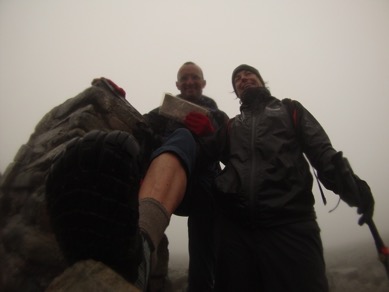
FinalSummitAt the trig point Mel and I had a hug to celebrate an epic day before the final long descent. We heard shouts from Matt who’t been sheltering by a wall until we came by. He was very relieved to see us. We seemed to get a second wind now and felt like we were motoring. As we approached the final track the clouds cleared at last to reveal the most amazing sunset. We all stopped for photos. On the track Mel and I ran the final half mile to the car. It felt so much more comfortable to run at this point than to walk.

Paul had not come to the finish instead taking responsibility to ensure we had food to eat and booze to celebrate with. This meant we all had to squeeze in to the jeep. Jimmy and Matt were so thankful of our help and it made my day when they told us that our little group was so refreshing as we were so upbeat the whole time in the really shitty weather.

Back at Betws-y-Coed John and Gwenn had set out a lovely table for dinner. Paul and Lotte had sorted out booze, Paul had collected the takeaway curry which was being kept warm in the Aga. Quick showers before a great celebratory meal. A few beers later and we were all ready for bed.

img_0767-3We set off at 3:15am and finished at the car at 9:45pm a total of 18.5hrs. We left Snowden at 5am and arrived at Foel-Fras at 8:30pm giving a time of 15.5hrs for the challenge. It was fantastic fun, not just the challenge but the banter all weekend made for a great little trip. Looking forward to getting Paul round the full challenge next year.

Posted in Barefoot Running, Big Runs | Tagged , , | Leave a comment

Dawn Till Dusk

Earlier this year I received rather a surprise when I got a place in Otillo. My friend Andy had suggested we enter and try to get a place on merit. I thought it a great idea but assumed merit would require a rather better race CV than we had. Andy took all our best race results and achievements, clearly spinning some magic, as we got in on merit.

So, on September 1st the two of us will set off at dawn with a few other teams to race an island chain in Sweden running the islands and swimming between. Over 60k of running and 10k of swimming across 23 runs and 22 swims. The rules are pretty thin on the ground which means you can swim with pretty much what you like but you have to carry it all with you.

Transitions here are far more important than they are in triathlon since there are 44 transitions during the race. This means every second added to each transition time is pretty close to a minute on your overall race time. Adding a couple of minutes getting in and out each time would add an hour and a half. It would appear transitions could be a key factor in hitting all the cut offs.

Since you can use pretty much any swim kit you like I’ve had lots of discussions about what to use. Despite my lack of kicking when swimming my coach is adamant that I should use fins. I’ve more or less written this off for several reasons other than I don’t kick. Firstly there are 65 kilometres of running so using my legs in the swim seems crazy. Secondly most of the entries and exits appear to be treacherous, across slippery rocks, probably requiring putting the fins on and off in the water thus adding timing to everyone of those 44 transition. Thirdly, they need to be carried for the runs and I’ve even got a fourth reason; as I’m the stronger swimmer there seems no need to go adding speed to my swim.

The use of hand paddles appears more or less a certainty. Gordo advised training in a paddle bigger than the ones you’ll race with. I hunted out the biggest paddles I could find and have start using them for lots of main sets. For the first time in my swimming career I can now swim faster with paddles than without.

I’m currently on camp in Lanzarote and the morning of my flight out I woke suddenly with a brainwave. I found my old Blueseventy Helix wetsuit and cut it down to above the knee and above the elbow. I then hunted down an old pair of Vibram Fivefinger Bikila running shoes. The hotel we’re in is about 2 kms from the sea so provides an excellent opportunity to practise running in the wetsuit and swimming in my running shoes.

I’ve done four practise swims now and have noted quite a few things. Firstly the cut down wetsuit is a joy to swim in. I wish they’d make swimming wetsuits with short legs and arms. The flexibility around the shoulders is improved and getting the wetsuit on and off is a breeze. Provided I keep swimming hard it’ s perfectly warm but if I cruise it’s borderline. Given the water in Sweden is colder and my partner is a slower swimmer working out how to keep warm is something I’ll have to think about.

The swimming in Vibram Fivefingers is fine. They don’t appear to get lose at all when wet, they feel ok kicking and running in them soaking wet is absolutely fine. I reckon it’s because they’re fit so snug around the toes and heel so there is no movement. I’ve noticed that several people hanging on my toes far easily than normal and it’s made me wonder just how much drag the shoes create. I plan to test this in a pool. There is not much to do about it as shoes need to be carried and I’m reasonably certain it’s better to wear them than to some how carry them on the swim. It it is, however, interesting  as if they are slowing me down it would illustrate how important foot position can be for swimming.

There are still things I need to experiment with and figure out. One is taking a wetsuit down to my waist and putting it back whilst running when it has a zip that zips up from top to bottom. For the longer runs we will certainly want to run with it around our waist as even running the mile from our swims here creates a lot of heat. The simple answer is a wetsuit that zips up the traditional way. There’s also carrying the required gear. We’re hoping that a small bum bag can be inside the wetsuit as swimming with stuff outside will cause too much drag.

All this worrying about the transitions and kit is good fun but what I really need to figure out is the small matter of getting run fit enough to complete 65km of running.

Posted in Triathlete Europe | Tagged , | Leave a comment

TSB Syndrome

There was a time when training was all about chasing numbers. Any decent race result I had was all gravy. I remember tracking week to date and year to date totals for distance and time across all disciplines. The week to date number proved the figure to chase as my performance appeared to correlate with that number. Please, note I am not claiming any scientific integrity here. Soon I tweaked it so I could make it any period “to date” recognising that the training for some prior period was what contributed to performance. Before I knew it I had something quite complicated coded in to a spreadsheet that attempted to weight all previous trainings’ effect on today’s performance. Luckily I enjoyed the process of writing this spreadsheet as it was a fair bit of work.

Then someone, I can’t remember who, told me that it sounded like training stress. I did a little research and a whole new world of data opened up to me. The penny dropped. I’d been re-inventing the wheel but I’d really not done that good a job, what I had was a little more like a square.

That was the start of me tracking training stress balance (TSB). Initially it was in a spreadsheet using my own calculation, then in my own database and final I happened upon RaceDay Apollo. Finally I had a tool that I could calibrate and have a good sense of it’s predictive capacity. Last year I was reasonably meticulous with all my testing and ended up with an accurate model; for my final test it predicted my result within about 2% of my actual result.

Used correctly (a big proviso) such models allow a high level of control and feedback over how you are responding to the training you’re doing and whether it is appropriate for achieving your goals. It can provide great motivation to keep doing the work and a timely reminder if you’re training isn’t quite right. It also allows no hiding from your loss of fitness when you’re not training.

This brings me to where I am now. The year had started full of motivation to get out and train, to test and to progress. The weather conspired against me but I managed some excellent consistent swimming and a series of solid turbo sessions. Fitness was improving; I could see it in the graphs. Then just before my first calibration test my nephews visited and right on cue three days later I came down with a horrible cold. Sleepless nights due to coughing fits and the days just seeing my fitness ebb away in my training stress graph.

On a rising fitness curve I find my motivation is self-perpetuating however on a declining curve my loss of motivation seems to keep gathering momentum. It all reminded me of the Hubbert Curve.

It wasn’t anything quite so dramatic. I’d got myself another dose of what I call; TSB Syndrome.

The drop off in fitness I was seeing was so de-motivating it just lead to more lost fitness. Soon I couldn’t bear looking at the graph. To be honest it got to the point that there was little point. My “negative” graph had zeroed out, which I tried to take as a positive since it showed I had no lingering fatigue. Surely my return to form would be a breeze being so fresh. However, my form and “positive” graph looked pretty much arrow straight towards zero and that meant back to square one.

It’s at times like this I wonder about getting a coach. You want the data, it’s helpful, but as an athlete it can be much more productive to get all the data and use it but without actually having to look at it yourself. Being self coached this isn’t so easy.

What’s the cure? Firstly; back to basics. Just get out and do. Get the data but don’t sweat it. Having had nearly two weeks of zeros doing anything right now will help. With our first training camp coming up there is a focus and it gives me motivation. For camp, the key thing is bike fitness and past experience suggests that two weeks of solid riding will see a return to fitness.

After that’s been logged I can start looking at the data again.

Posted in Performance Management, Triathlete Europe | Leave a comment

Starting Back

Finally I need to get back in to training. Following Ironman Florida I had my most comprehensive end of season break since starting in Triathlon. I stopped weighing myself, stopped taking my resting HR, didn’t give a hoot about what I ate or drank and I never forced myself to train. This culminated in a thoroughly enjoyable Christmas and New Year racking up numerous back-to-back zeros.

Now I feel thoroughly untrained and almost back to square one. It’s as if I’m starting my triathlon career all over again.

Starting out in triathlon a good first step is to just get out and train. No need to worry about all the fancy jargon; periodisation, FTP, intervals, threshold, heart rate zones or whatever the current fashion is. In general doing something is better than doing nothing. This means getting out the door and putting your body under some sort of stress. Go with the flow, if you’re tired rest, if you’re feeling good crank it.

That’s how I started in my triathlon career and this phase probably culminated in 2007 with completing 100 hundred mile rides in the year. This resulted in, probably, my best ever Ironman performance and my discovery of Eddington Numbers. Just getting out there and doing works. It doesn’t matter what motivates you (for me it’s statistics).

The next step tends to be trying to get a little bit more structured. Perhaps you get a heart rate monitor, a power meter. Perhaps you start doing some intervals, start thinking about recovery, nutrition and even training stress. Training stress attempts to measure the stress on your body of a given session. It removes the focus from time, distance or speed and instead gives you a comparable figure. It makes you think – you can get the same stress from short and hard verses longer and slower – it’s not just the amount of stress but making sure you get it in an appropriate manner for your goals.

After this the final step seems to be all in with the modelling. I started doing this a few years ago when I started using Raceday Apollo (RDA). This is a wonderful piece of software that allows you to calculate your training stress and the model your response to stress. You have to to tests to work out your thresholds to accurately measure training stress and then you have to do tests to calibrate the model to fit your personal response to training in each of the disciplines.

This gives a whole new level of interest (if you like the numbers) and it’s great when you’re returning to fitness after your end of season break. You not only feel you’re getting fitter but you see it in your test results and you see it in the training stress graphs.

As I start my journey back to fitness I now follow the above progression but sped up. The priority in the first few months is to just get out and train. I ditch my power meter and heart rate monitor hop on my fixed and just go with the flow. Whatever it takes to get me out, meet friends, head to a favourite coffee shop or set some silly statistical target. Often it can be as simple as racing against the previous January. The benefits accrue very quickly when you’ve years of training logged.

Unlike when I was a triathlon novice the next steps are introduced quickly. At first it is out of necessity – bad weather can push you on the turbo and it’s a pretty boring task without intervals. Also I need to build a useable model in RDA, which requires regular testing. In these first few weeks they are the sessions that will hurt most. After a few months this should provide me with base miles and a decent model, which will hopefully help me to some decent performances in the summer.

Posted in Triathlete Europe | Leave a comment

Challenges

I’ve just got back from day three of my “Advent Challenge” having run 3km. I’d announced this on twitter to see if anyone wanted to join me. Some of the reaction to it got me thinking.

Firstly I wondered if my definition of challenge was correct. My view being that for something to be a challenge there had to be some likelihood of failure. If success were a certainty would it still be a challenge?

I’ve used challenges throughout my athletic life. Perhaps it really started in my fell running days with trying to run up as many Munros as possible in a day. I progressed through the Fisherfield Fells before a failed attempt at the Trantor Round (19 mountains over 3000 feet around Glen Nevis).

Starting Triathlon cycling was my weakness. I needed miles in my legs and used challenges to help achieve that. In 2007 I managed 100 rides of 100 miles in a year. A feat I’ve tried again but always failed. Similarly I had one year of riding at least 52 miles every week of the year and again I’ve not managed to repeat it.

On Epic Camp I was introduced to the 30 runs of 30 minutes in 30 days challenge. At the time that was a pretty easy challenge so I soon advanced to 40 runs of 40 minutes in 40 days. This I managed prompting me to give 60 of 60 in 60 a go. Less than two weeks in I realised it wasn’t serving any performance benefit, all it was doing was making me ever more tired so I stopped and failed.

This highlights the key thing in a challenge for me. It has to serve a purpose. This could be pure enjoyment, assist some training goal, perhaps to impress your peers or just to prove to yourself you can do it.

With this in mind I started the advent challenge. My running has been well below par for years now and my feeling is I’m just not running enough. It’s vicious circle as not being running fit makes it less enjoyable and therefore makes me less motivated to run. This challenge means through advent you have to run the day of the month in kilometres. So day 1 1km, day 2 2km etc… In the final seven days this requires running 158km. This would get me running regularly; give a progression to higher volume and with luck get me over that initial hump delivering me in to the new year enjoying running again. I would say I feel 50:50 about whether I can complete it.

Following my tweet about it I had loads of encouragement but I also had a few suggesting it was the road to injury. I found this very interesting for a variety of reasons.

Firstly it implied that the challenge would somehow cause the injury. This is a bit like blaming firemen for fire, umbrellas for rain or even cholesterol for heart disease. Injuries are not caused by the challenge but by continuing when you shouldn’t. By not recognising your body’s signals that you need to back off.

Secondly it seemed to imply that the only method of failure was through injury. If this were the case then either you always set challenges that were certain (hence no injury) but then they’re not a challenge. Or, alternatively you would give yourself ever-harder challenges until you found one that you failed at and hence got injured.

As we enter the New Year and start getting in to base miles, challenges can be great tool to get you going farther or faster but be sure to allow yourself to fail, don’t continue mindlessly in to an injury. Learn your body’s signals that you need to back off and heed them.

Should I achieve the advent challenge the next stage will be to do something similar for a whole month. For a 31 day month that would mean running 196km in the final seven days. After that it would have to be following this protocol for a whole year. I.e. running the day of the month in KMs every day of the year. It would give a reasonable recovery week at the start of each month but I’m pretty sure that this, for me, would be a step too far.

Posted in Big Rides, Big Runs, Triathlete Europe | Tagged , | Leave a comment

Rhythm Of Life

I’ve spent most of today in what has become an off season ritual; chopping wood. This preparation at least two winters hence reminds me of triathlon, especially Ironman, where you need to plan ahead. Already I know all the races I plan to do next year. I have even entered all but one and I have most of my 2015 race scheduled pencilled in. On the one hand it’s a bit of a pain to have to enter so far in advance but on the other I enjoy the routine and rhythm this gives to my life. It certainly helps find coaching cover when I know my holidays plans a year ahead.

This is also the time of year when most of us reflect on the season and whether we met our goals. When it comes to “SMART” goals it’s been a pretty poor year. A sprained ankle put any defence of my Wimbleball Age Group title out of the question. Then getting freezing cold during the first two hours of Ironman Wales quashed thoughts of Kona qualification and finally major works starting on my house led to a very distracted final preparation for Ironman Florida resulting in the kybosh being put on my chasing a personal best there.

Fortunately, though I set some “SMART” goals I also have others. A goal that’s malleable enough to allow you to argue you achieved it. This one I achieved by enjoying all my racing.

A season review leads to goals for next season. Number one again is to enjoy my racing. After that it’s about resurrecting the goals I had for the year I turned 40. That season ended up a right off. Next year, aging up, I will try again: win my age group somewhere, qualify for Kona and get an Ironman PB. It’s good to make goals public; it gives some commitment and hopefully allows people to offer support.

It’s about this time each year when photos appear on various forums illustrating how bad the drafting is at Ironman Florida. I generally don’t take much notice as static photos tell you very little. I last competed in this race back in 2006 and didn’t see any particularly bad drafting. This year, however, was a completely different kettle of fish. I have never seen such blatant drafting. Being a quick swimmer I tend to spend a lot of time on my own on the bike and when groups pass it’s not so quick that I don’t get to observe them for quite some time. At Florida I saw numerous large groups come by with the majority riding in a formation you’d be chuffed with on the weekly club ride. I know this happens but I was shocked. Further back in the field you could see absolutely massive groups, two abreast. It would seem that if you have 3,000 competitors this is inevitable. However, up near the front where I saw these groups there was no excuse. There was plenty of room on the road for these groups to be riding a legal pace line and there are no hills that would get them bunched up.

So, whilst we’re all setting our goals how’s about the WTC setting themselves a goal for next year. Having focussed this year on trying to improve the swim starts by experimenting with different approaches (the corrals worked well at Florida), next year focus on trying different approaches to combat drafting. For me, the simplest way is to do what they did at Ironman UK in 2005 when I raced my first Ironman. Simply don’t issue penalties on the course, don’t even tell people they’ve got a penalty. Let them find out when they arrive in T2. If they happen to have got two drafting penalties their T2 bag will be removed as they’ve been DQ’d. I’m convinced that many of these cheaters are doing it on the basis that the 4 minutes they lose if they get caught is far out weighed by what they gain. They’re happy to risk this knowing they’ll get a second chance and at that point will ride legal. Without knowing whether they’ve been penalised then merely having a ref ride by will be sufficient to keep most people racing within the rules.

I remember knowing some city workers that wouldn’t buy a ticket for the train if they knew it wouldn’t be checked. It made me mad, you don’t buy a ticket because it’s going to be checked, you buy it because you’re taking the train. It’s the same here, you don’t not draft because you may get caught. You don’t draft because it’s cheating. I think a distinction needs to be made. There’s the case where you drift in to the draft zone, don’t make a pass quick enough or don’t drop back quick enough. This is part of racing and a penalty is appropriate for infringements. Blatantly sucking someone’s wheel for an extended period is cheating and if caught should be a disqualification.

Posted in Triathlete Europe | Leave a comment

Ironman Florida 2013

Swim: 0:54:56
T1: 4:12
Bike: 5:00:57
T2: 2:26
Run: 4:18:19
Total: 10:20:50 (48th / 280th)

I managed to get a solid 4 hours sleep before waking every half an hour. As ever once I get up all nerves disappear. Sharing an apartment with friends also helps calm any pre race nerves. I forced down three scrambled eggs on a toasted bagel with lots of butter. I was in transition checking my bike at 4:30am and was home by 4:50am with over 2hrs left before race start. I managed to relax and mentally prepare. We wandered down to the start at 6:15am.

SWIM

This race had one of WTCs swim start initiatives. Running across the beach there were marked areas for estimated swim time. It started with sub hour to the left and in direct line with the buoys. Then 10 minute blocks as you went right (and further from the most direct line).I’d decided to go to the front of the 1:00 – 1:10 block but shifted one group further over when I observed the surf coming in as it seemed worse further left.

We got a true impression of how big the breakers were when the pros set off. National anthem then we were off. Unusually they give a full count down down to final 10s and set off bang on 7am. The surf was great fun requiring diving under it and working hard to get clear. After a few minutes I found myself with the lead AGers. Pretty clear that the fast swimmers had made a similar start choice to me. I stuck with the front guy for about 500m before deciding it wasn’t worth the extra effort.

At the end of the first lap I got clobbered by a big breaker I tried to body surf in on. I managed for a while before it forced me in to a forward somersault. The second lap I cruised. I bilateral breathed and focussed on what my coach has been working on for ages now – long strong strokes holding the water as best I can. I reeled in and passéd some of the swimmers ahead and by halfway through the second lap found myself catching pros who had started 10-15 minutes head.

I really enjoyed the swim and was very pleased with how I went. It was tough conditions though that tends to make it more fun.

As I exited I heard them announced the Mirinda Carfrae was coming out of the swim.

T1

Wetsuit strippers are a highlight of US races and this race did not disappoint. Wetsuit off in no time then the run through transition . It has a fair bit of added distance to run to the change tent and back to the other end of transition to ensure it’s fair. as you come to your bike rack a volunteer is there holding your bike. Great support.

BIKE

I was in a good frame of mind as I started and set off at a decent pace. Caught a few people and was passed by a few including Mirinda who I wished good luck. Make no mistake, this course has very little on the scenery side, even when running along the coast a lot of the time high rises block any view. it is however pretty much completely flat and on very good road surfaces (bar the middle 10 miles). There’s also only two dead turns in the whole course, all other turns can be done whilst staying aero and not braking. It’s fast.

I felt comfortable and was seeing good power numbers. It was a fair while before the first group of AGers came through. They were riding legal, I pushed on a bit but soon decided not to go with them. At about 40 miles a larger group came by and they were proper close. At the back was a Pro lady who said something to me about getting swept up by them, I commented they were a bit close. She agreed and clearly was not happy. At the next penalty tent I saw her and felt sure she’d been caught out by these AGers cutting in as they went by.

Still my power was looking good so I wasn’t too bothered about being passed so much. The bumper section from mile 50 to 60 is pretty unpleasant but at least it’s an out and back so you can check out where you are. Given the power numbers I was seeing I was stunned to see how close Roger was to me. He was clearly having a great ride.

Not long after this another big pack went by and if the last one was bad this was ridiculous. They’d have done well to ride closer on a organised club ride. No shame whatsoever. I certainly gave them a piece of my mind and was able to stay close enough to see that very few of them were making any effort to ride legal.

Further back in the field there may be some excuses about not much real estate to spread out but at this point in the field there was tonnes. Throughout the race I would spend huge chunks of time on my own without anyone in sight and then get swept up by a group. There was plenty of room for them to ride a legal pace line. It’s in such stark contrast to my experience in Busselton where it seems all the faster AGers know how to and want to ride in a legal pace line. This was nothing short of blatant cheating in my book and unfortunately makes me look at any cyclist that start behind me and finished ahead on the bike as if they cheated.

Not long after this I saw Mirinda again. She seemed to have slowed a lot so as I went by I asked if she was ok. She looked a little non plussed and said “Yes” with an unsaid “of course”. I then asked if she was just validating which she confirmed. I said I felt it was a stupid rule and that people like her just completing to validate may help bring the rule to an end.

The final section was largely with a tail wind and I needed to do 40km in the last hour to get sub 5 hours.  It was great fun but I fell just a little short. My power for the ride (normalised) was 261 watts which sounds amazing BUT as I finished I realised that it couldn’t be a correct reading. No way could I only do 5hrs in those conditions if my power was that high. I will try and do some comparison to Rogers power (he went 6 mins quicker) at some point.

I finished the bike still in a great state of mind knowing I was starting the run with about six hours on the clock.

T2

Nothing much to report other than nearly forgetting my race number. We didn’t have to wear it on the bike which meant we had to get it out of our T2 bag. In 26 previous Ironman races I’ve never had to do that.

RUN

I decided that I would force myself to run properly from the off. I’d been wondering whether recently I’ve never allowed myself to get in to my running. After the first mile I felt great and was running well ticking off 4:30 KMs. For the first time in ages I was passing people on the run rather than being passed. The good old days. The speed I was going enough to get me a PB though I never really believed I would survive that pace till the end. I managed it to halfway through the first lap. I’d stupidly made a deal with myself to make it that far and after the turn my pace dropped and soon I was run walking. I decided if I was going to run / walk I would make sure I ran properly when I did run. For me this meant 4:45 / km pace. Unfortunately the amount of walking slowly increased till I must have walked for 20 minutes to the halfway point of the second lap.

I had quite a mental debate about whether to continue Ironman racing (despite already entered two for next year). It seems pointless if I’m going to walk the run. It’s meant to be a run. I did another deal and said after the turn I’d set a beeper to go every 2 minutes and go 4 mins running and 2 mins walking. This I stuck to and ran well for each 4 minutes. It felt good. In fact, the first two minutes of each 4 was more comfortable than walking but rapidly in the second 2 minutes it became tough and I was wanting to walk. I vowed never again to enter a race this under prepared. Then I remembered I’d made that vow after most of my races of the past two years.

I crossed the line with relief. I’d enjoyed my day. I confirmed my swimming is going very well. My ride was very satisfying showing I’d kept a lot of my bike fitness despite doing very little since Ironman Wales. My run was awesome for 10k, it felt good and a little like the good ole days. It was a fast day and I’d have had to PB to have got a Kona slot. Thats some consolation. My pace in that first 10k would have had to continue for the whole race to qualify. Thats also some consolation.

Posted in Uncategorized | Tagged , | Leave a comment

Anatomy Of A Training Camp

I’m sitting in front of my new wood burner as the first cold snap of autumn hits. Everyday I check in on what’s going on in Kona, which renews my drive to get back there one day. This edition of Triathlete Europe is bound to be full of Kona news so I thought I’d end the magazine on a different note. Since this may have inspired many of you to chase the goal of Kona perhaps a winter training camp will help. Jo (Carritt) and I have our own take on what we want to offer on a camp and through EverydayTraining, the coaching company that we have built together, we have been able to organise just that. A camp as we would want it, and we believe that as well as great training, our camps also provide a unique experience.

Below is an outline of the anatomy of one of our camps:

  1. We’re in this together – no sessions are optional. Everyone on the camp has the overriding goal of ‘completing’ the camp. This results in all campers really supporting each other – from the fastest to the slowest, everyone is challenged.
  2. Limited flexibility – we provide a method whereby you can earn a slight reduction in the following days training. This allows a certain amount of tactics to complete the camp and provides the possibility for athletes to help each other by trading.
  3. Completion – this came from our experience on Epic Camp. We provide a set of daily minimums, which need to be done to complete the camp. It’s nothing more than being able to say you did (there’s no completion medal) but it motivates virtually every camper.
  4. Competition – with high volume camps intensity is often difficult to come by. By having regular competitions it ensures some more intense work and also lets people discover they can still go pretty hard even after a tough few days training.
  5. Make It Social – many friendships have been forged on camp and we like to build a good group feel without cliques. We keep our camps small enough that we all have meals together. Also, since everyone does all the sessions there’s a big shared experience, which helps provide some banter at the end of each day. I’m proud that each camp has produced it’s own great feel, and running “in jokes”. As an example, the camp last March was our “G&T” camp; where athletes took it in turns to host pre-dinner drinks and nibbles on their balcony.
  6. Mix Of Abilities – it’s great to get strong experienced athletes alongside newbie’s and weaker athletes. Our rides are scheduled so that groups meet on the road (often more than once) or where café stops are possible we aim to get all groups arriving at the same time. We handicap races and competitions such that everyone has a chance to win, and therefore equal motivation to produce their best. Each of our different camp locations has a different method for this and all have proved successful. More often than not, we’ve reached the end of the camp with the fastest and slowest athlete both still in the fight to win the camp prize.
  7. Train Like A Professional – we aim to provide the “train like a professional” experience. So we ensure that campers don’t have to worry about anything other than training and recovering. All meals are provided. Massage is provided together with sports nutrition and recovery products. We even have a physio along to help with daily stretching and to provide treatment if the need arises.
  8. It’s a TRAINING Camp. Our camps are six days of training. The days are filled with swim bike and run. No formal talks are given – instead advice can be gained during conversations on the road, at the café, over the dinner table. And not only from the coaches, either. Others on the camp have experiences to share on the and we encourage this pooling of knowledge, and opinions amongst the group.

Next year will be the fourth running of our Lanzarote Endurance camp and we’re pleased that from each of our previous three we’ve had at least one person qualify for Kona. I’m hoping that next year I’ll be one of them.

Posted in Everyday Training, Review, Triathlete Europe | Tagged , | Leave a comment

Ironman Florida 2013, Preview

This race has rather crept up on me. It’s race week already and I’ve not even thought about checking my bike or packing. Other things have rather taken precedence which isn’t a bad thing. I love racing and training for Ironman so if something comes along that you’d prefer to do and takes priority thats got to be a good thing.

Following Ironman Wales I was pretty positive about my prospects of qualifying for Kona in Florida. Now, however, qualification will have to be at Ironman UK next year and this Saturdays race is all about hanging out with Rodger and plain and simple enjoying the race. What happened since Wales that’s lead to this.

Following Wales I had a couple of weeks recovery before heading out for our first EverydayTraining camp with Tri Sport Lanzarote. That was all to plan and the camp did just what I’d hoped; kick started my fitness. At the end of the camp I did a sub 30 minute ascent of Tabeyesco on a hire bike. It was a really good sign.

Returning to the UK I got a cold. Pretty much as expected and to my surprise it didn’t last the 10 days it always seemed to last year. In fact, it only briefly interrupted my preparation. However, just I as felt better I met with the builders who’d we decided on for major works on our house. They said they could start a week later. This meant I had a ridiculously busy week of, more or less single handedly, packing up the whole downstairs of my house and moving out.

Then the work started. I knew I’d be interested but hadn’t appreciated just how interested and how distracting it would be. For a period I was so torn, feeling guilty about not doing the training I’d planned. Eventually I resolved this realising it’s a good thing that there’s something more important than the race. I embraced it, stopped worrying, did what I could and let myself enjoy the whole process of adapting my home to be more sustainable and better able to help us deal with what the future has in store.

I thought I’d take a little look at how my fitness has progressed since Wales and give a prediction on my race. I did this race back in 2006, it’ll be interesting to see how it’s changed and how I compare to back then.

SWIM

_swimFlorida13.jpg

Swim training has gone very well largely because it’s always done first thing so the work doesn’t interrupt it. For quite a while now my coach has been focussing on trying to lengthen my stroke. With the start of this swim season there was a big focus on skills and since then in all my training I’ve never sacrificed my stroke count for speed. It’s meant that though I’ve been working hard my training times haven’t reflected speeds I’ve hit previously. I’ve been very confident that this will ultimately pay dividends. Over the course of the last four weeks I’ve seen snapshots of how it can be. It starts to feel more natural to kick a little, I feel more stable in the water, I feel more controlled and more relaxed. Last week I found myself on 5:05 400 pace whilst holding my stroke count. Almost back to my fastest (as a triathlete) but on five strokes less per 25m ! Then last friday I was cruising 32.x s for 50m, again whilst holding my stroke count. I am swimming well and looking forward to it. Just a shame that this week a pump has broken at my local pool so I haven’t been able to get a final couple of 2 hour sessions in which I felt would set me up great for Saturday.

In 2006 I swam 58 minutes and I felt I’d had a good swim. I’m swimming better than back then BUT that was still slow. I remember that it was a tough swim. So bearing that in mind:

SWIM: 54 minutes

BIKE

_bikeflorida13

Before anyone gets excited this isn’t predicted Ironman wattage ! I wish ! This is prediction based on the test which I do to calibrate the model. This season I’ve been using a 10 minute TT on the turbo, aero bars for power. It doesn’t compare with the peak test performance in the summer of 365 watts though I couldn’t face another test in this period. It’s clear that my biking shouldn’t be as good as at Wales. My training has been very low volume (just under 150 miles per week since getting back from camp) but the rides I’ve done have been at good power numbers. This is encouraging but perhaps it’s because I’m fresh. It’s not been tested over a long distance but I think (probably more like hope) I’ve been doing enough to have maintained some pretty decent form.

I’m certainly biking better than when I did this before but I may not have the same endurance as I did back then when I rode 5:11. I also reckon I’m a bit better at executing a Ironman bike and certainly better at riding flat courses.

So… this is probably more from the heart than the head:

Bike: 5:05

RUN

_runflorida13

This is where I had (have?) high hopes. I fell apart, yet again, at Wales but managed a great final 6km and convinced myself a big part of my performance is down to lack of mental strength. I had high hopes to get several long runs in and really get in shape. It didn’t happen. Well… nothing quite as long or as frequent as I’d hoped. However, some was encouraging. I am consistently running faster. The week before last I did a 25km run in 1:52. Just over 4:32 KM pace. I went thorough half marathon in 1:33. I even finished it strong feeling I could keep going. Then last week I did 28km holding 4:45 pace and completely fell apart at 24km and felt so ill that evening.

For the long term this is encouraging but for Florida I just can’t get away from the fact the work has not been put in. So here based mostly on head with a little smidgen of heart thrown in:

Run: 3:45

If only I was running like in 2006 when I thought I’d fallen apart and had a terrible run coming home in 3:18 ;o)

I didn’t add these up ahead of time, so here goes, assuming transitions similar to last time:

SWIM: 0:54
T1: 0:03
BIKE: 5:05
T2: 0:02
RUN: 3:45
TOTAL:  9:49

I’ll be honest I’d be happy with that even though it’s probably 20 minutes off whats required to qualify.

Posted in Race Preview | Tagged , | Leave a comment

Tenby

It was several years ago when Ironman UK was moving from Sherborne and there were teasers out about a fantastic new location that I was chatting at a café stop and discussing where we thought a good race location would be. I felt a holiday resort out of season was ideal as the races I’d most enjoyed were where everyone could and did stay in the same location and all the race venues were within easy reach. I remembered how the Waikiki ITU World Championship in 2005 had felt like being a student again as you would head to a local coffee shop and keep bumping in to people you knew.

Now I’m sat in a coffee shop in Tenby a few days out from Ironman Wales. It’s my third year racing here because it is such a good race. It fits my holiday resort out of season criteria just perfectly. Tenby is a beautiful little town in an area of immense beauty. It’s economy must be based off tourism and as such there are tonnes of accommodation options resulting most people racing will be staying within easy reach of the town. The bumping in to people comment has been confirmed by my taking nearly an hour to walk the 500m from the Expo because of meeting people I knew.

This race has that lovely incongruity that I love when racing and training from Puerto Del Carmen. There the majority of the people are drinking and partying till dawn making us athletes quite a contrast. Here in Tenby the majority seem to be old age pensioners on bowling tours or just here for a relaxed break sitting looking out to sea. Over the three years their knowledge seems to have increased. Gone are the looks of shock and horror when the Ironman comes up in conversation to be replaced by knowledgeable comment and disappointment at leaving before the race.

Over the years the town has embraced the race. The first year they seemed a little bemused and more concerned about the road closures. Last year many sounded like experts and places started having Ironman specials which already appears to have increased this year. This coffee shop I’m in now has already discussed with me that they are going to be putting on several items specifically for the Ironman. “Lots of pasta” I heard. I couldn’t help but point out that wasn’t my thing but it probably was for the majority.

It feels like history is being built with this race. I’ve been to every one of them and at the moment I don’t really see why I won’t continue to race each year. The town is embracing it and adopting the race, it’s lovely to see. My worry is the race will get too big for the town and the commercial interests of a private equity firm will force it to move. That’s the problem with this part of our sport being run for profit, there’s no monetary value placed on the feelings of the local people that make a race so good.

Back when we were having that conversation I’d been thinking that perhaps Blackpool would be a good location. I didn’t know Tenby but it is perfect. For starters the bay the swim is in provides a brilliant amphitheatre for spectating. Even for the swimmers it’s fun, cliffs to look at, anchored boats to dodge, a lifeboat ramp to aim for, then a shard of rock and swim and run around.

The long T1 was forced on the race due to bad weather in the first year but now I think it’s a selling point. Running though the big crowds getting cheered on is awesome, reminding me of T1 at Wisconsin when you run up the spiral exit ramp of a multi story car park with massive crowds either side.

Then there’s the tough bike. It’s so British, it seems we love tough courses and this fits the bill perfectly. No big cols to go over so it can deceive but just look at the bike splits and you see it’s got to be one of the slowest in the world. Finally there’s the run, 4 laps with at most 500m of flat running. It’s either up or down. It’s a perfect mix with half the lap outside of town where spectators are thin on the ground allowing you time with your thoughts. Then you return to Tenby where it goes up and down every street allowing spectators with initiative to see their athlete a couple if not four times each lap.

I’ve raced around the world and I’ll admit my experience of all iron distance races is they are great fun and well run but if I was to rank one as the best (outside of Kona) it would have to be this race. So, if you’re thinking of Ironman, give this one a go next year but please don’t enter too quickly as I don’t want to miss out!

Posted in Triathlete Europe | Tagged , , | Leave a comment