Run Consistency

runconsistencyFinally arrived in Kona after a long but reasonably relaxing 2 days of travel. It gave me lots of time to work on my new training Database and try out some ideas I’ve had.

I am a firm believer that consistency over a period of months, years is what really is the key to Ironman success. It out trumps volume to a point. By this a mean consistent week in week out periods of moderate volume are better than doing some monster weeks and then being a couch potato for one. I’ve been spending a lot of time recently moving all my training data into a database I’ve built. This harps back to my old life as a data modeller and programmer and it’s given me a great deal of pleasure. I remember that I did actually enjoy my work!

Having my data in this form and allowed a load of “Data Mining” – I’ve seen some interesting things and I may blog on that at a future date. It has allowed me to experiment with trying to measure and track “consistency”. I wanted to try and capture the essence of what I feel is required and back test it against my performances. A big part of this is to be able to start to use this with my athletes. This is very similar to the idea of monotony (standard deviation of daily load) and strain (average load divided by monotony) which I track. There are problems with this

  1. I don’t want to look at consistency on a daily basis. How the week is split up doesn’t matter so much as much as overall volume for the week. NB: this is not a fact, it’s just my opinion that I will try and test against my data
  2. I’m saying consistency is good so I low standard deviation is good. For what every reason I like bigger numbers to mean better things … so I went with 1/standard deviation
  3. Other problem is that standard deviation would mean doing nothing was good … thats bad. So I multiply the lot by the average load squared. Needed to square it as consistent very low volume produce such a low Stdev that it outweighed the low load.

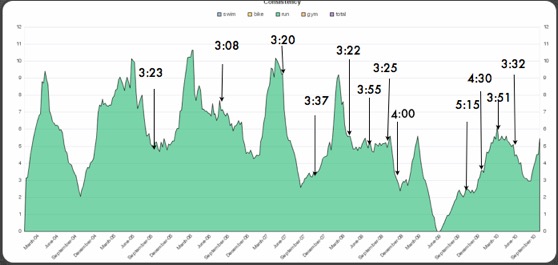
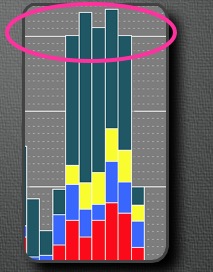
I tried loads of different methods of trying to measure what I wanted and none quite worked as well as I’d hope… I will still  play with it but so far what did I get ? Well a reasonable surprise – it kind of did the job. I’ve set it up so I can tweak the period I look over. So the graph above looks at consistency weekly by looking at how consistent training has been for the previous 12 weeks. It shows my Ironman Marathon times and where they sit compared to consistency.

My first three marathons are more or less my best and they show they follow a solid period of consistent running. After that the times have dropped and really the steady improvement post injury has come off the back of consistent running. After Lanza I had a decent break this year but now I’m seeing consistency figures which I’ve not seen since Lanza 2007 which was probably my best Ironman Performance.

How does this fit with the volume I was doing ?

RunConsistency2

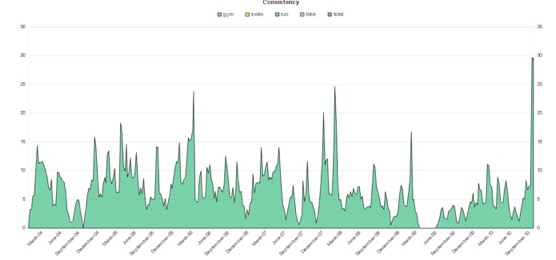
This shows consistency in red with weekly bike mileage in Blue.  You can see during period of good consistency and fast running I very rarely went above 80 miles per week. I certainly fell in to the trap of more is better with my running. Hammering out 100 mile weeks (this work for Ironman NZ 08) but I think long term is just so training that consistency is sacrificed as very low volumes are needed to recover. I’ve bourne this in mind in this build period (more in a later post) and really held myself back. If I’ve hit volume targets by Saturday I haven’t used Sunday to go beyond them I’ve taken it easy. I’ve had a few very pleasurably Sundays taking it easy these last months something I never used to do. My run mileage this last 4 weeks has been 50,52,51,52…. This consistency really shows up if I do the analysis using rolling 3 weeks. Since this period was more consistent than I’ve ever managed it outweighed any other period of running despite the relatively low load. Here’s the graph based on 3 weeks.
RunConsistency3

Thats consistent. Lets hope I prove it’s worth come a week Saturday.
Posted in Training Review | Tagged | Leave a comment

Kona Bound

konabound.jpgThe bike is packed up. Today I did my last over distance ride and tomorrow provided I manage an 8 mile run and 55 mile ride I’ll have hit my targets on my final push week. Things have gone well. Take todays ride – 200k with the first 4h45 “depletion” – no calories just water. I then fueled up on carbs and hit the final 2.5 hrs. That final section had a normalised power of 238 watts and in the final 45 minutes I managed a CP10 of 354 Watts. I felt pretty good which was encouraging as I’ve really not been too certain how my biking was going.
This means I’ve managed to execute the 10 week plan I had. It was relatively simple – 5 weeks of 30 hours  then 5 weeks of 40hrs. Each week including long bike, long run, 4hrs gym and 20k swimming. Once in the 40hr weeks some over distance riding. I’ve more or less done it all giving me one of the most consistent builds I’ve had in a long long while. Despite that it’s difficult to judge how I’ll go but I’m quietly confident.

Last year the big feeling heading to Kona and being out there was of privilege and luck. I’d qualified pre injury but I really wasn’t in the shape that “deserved” to be there. I wanted to soak it up as there was a big chance that would be the last time I’d race. At the time there was no evidence that I’d get my running back. This year … I just qualified getting the final slot at my final opportunity to qualify. I just scraped in by holding it together on the run at Lanza. It means I feel immensely proud to have got to Kona. Probably the proudest I’ve felt of any of my trips. This has definitely helped me prepare, it’s kept me focussed.

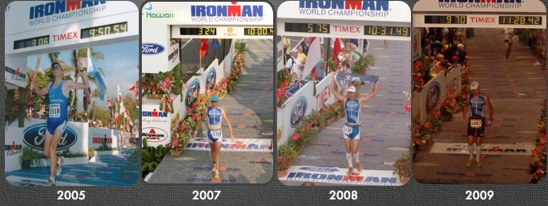
The pictures above show my Kona sequence:

9:50 — 10:00 –10:31 –11:28

My best time is still in my second ever Ironman racing on a touring bike ! If that sequence continues that would mean 13 hours this year !!

Leads me to my goals for the race. In order of difficulty:

  1. Break the sequence above – ie not be slower than last year
  2. PB the course – ie under 9:50
  3. Sub 9:30 – swim: 55, bike:5:05, run: 3:20 + transitions. Dream race

The main one is number 2. I’d be very pleased indeed to manage that. The final one is what I’ve felt I could do if I have a great day but I must admit that right now I just don’t know how my running is going. I’ve intentionally been just running on feel and not really testing myself as I don’t want to put too much pressure on and allow my foot to get really strong. That said, my preparation has been a lot better than for Lanzarote so I feel I should be able to run under 3:30.

Posted in 2010, Kona, Training Review | Tagged , | Leave a comment

Aero Evolution

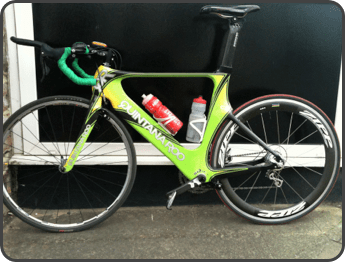
AeroEvolutionYes, another picture of my new bike. I’ve spent the last week doing all my riding on it and tweaking the setup. Slowly but surely the saddle has been pushed forward. It’s now as far forward on the post as it will and about 2/3rds along the rails. God knows what the effective seat tube angle is. I find I feel far more comfortable if I’m well over the bars so my elbows are at right angles. It now is feeling as good as the P3. Certainly it must be comfortable as I did 222km and 209km rides on the 3rd and 4th outing.
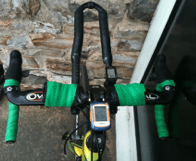
AeroEvolution1Getting the QR frame and forks has allowed me to get my ideal front end set up…. well what I think will be ideal. It’s important to remember this will be my only bike for the next 5 months so having a flexible set up is key. I’ve got Oval aero bars – the key point here is they have a flat top. This means that I’ve set up my elbow pads direct on the bar using some pipe lagging. They’ve very comfy and still allow holding the tops of the bars when climbing. I’m using the Oval SCCS stem system which allows changing the face plate to set up aero bars. For this I’ve got the “Under Only” system which means it just mounts the aero bars underneath. For the moment I’ve gone with STI shifters as this allows me to remove the aero bars and just ride it like a road bike. This will be perfect for the “Five Passes Tour” in New Zealand straight after Kona. Since I don’t have bar end shifters I’ve put an aero bridge on which really helps with the comfort. Having the drops gives great stopping feel and loads of different positions for you hands. It also has the advantage of great control on descents, more confidence whilst staying aero in strong cross winds and also (I tested this in Lanza) my terminal velocity is higher when hunkered down on the drops then on the aero bars.
For Kona I plan to race just like this. For Busselton I plan to put a bar end shifter one for the rear derailleur. After that race I’ll be able to say whether I feel it makes much different.

Many moons ago having found out I’d got in to Half Ironman UK I decided I’d better buy a road bike. My luck or judgement I went to Bike Park and had a proper fitting. It felt like the right thing to do. Since then I’ve had one other fitting but I’ll be honest I’ve never not been comfortable on a bike. In fact, before buying my Indie I did a test ride on a XS which was clearly too small for me but still did 125 miles straight off without any problems. I think I’m just very tolerant of position on a bike.

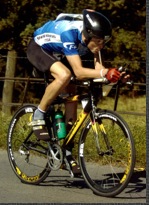
AeroEvolution2For my first season I just whacked on clipons. I’ve looked for a photo but I can’t find one but I feel pretty sure I’d have been more aero on the drops. The next season I bought Hed Aero bars and Hed Alp wheels as that seemed the thing to do. I was planning to switch my road bike to use them for the season but soon realised this was impractical so I got a previous years Giant TCR Aero frame. It was cheap and it was probably a size too small.  With hindsight I think this was luck – it was compact and I could get pretty aero. From early on I just tried to got as low as possible. This seemed more aero to me and though there’s often said you need to be comfortable for Ironman my feeing was I should just get comfortable in that position by riding in that position. The photo is me at Ironman UK heading towards my first Kona spot.

roberts-2Heading to Kona I decided to take my Touring bike. Yes you heard right ! It was the easiest to travel with. Back to clipons, forward pointing seatpost and a 45 deg MTB stem on upside down. Here’s a piccie. Thats still my best Kona performance which shows it’s not about the bike.

I went the next two seasons with the Hed full on aero bar set up but moved the bike underneath it to a P3C. The second of those seasons I did both Lanzarote and Kona and at both I concluded that the bull horns were not great for some of the descents and cross winds. I think some of it may have been particular to those bars – the integrated brake levers didn’t give a confident feel. The bull horns were small and smooth. I ended up putting MTB rubber grips on them.

Following that season oval came out with their SCCS system. I put that on my P3C with normal drops and the “Under Over” face plate – this put the aero extensions under the bars and the pads above. This pushed me further forward getting my elbows at right angles and it was noticeably more comfortable. The main issue with this system was that the pads covered so much of the tops of the bars it wasn’t that comfortable to ride with hands on the tops or the corners. My other line of thought was that by having drops the bike became more comfortable for day to day riding and I would use it more. Riding it more regularly seemed like a good thing. With hindsight I can see that proved the case as by the time I cracked this P3 I’d done 20,000 miles of riding in 3 years.

AeroEvolution5I was so happy with this setup I got an oval stem on my road bike and at the National Relays raced with the under only face plate and home made padding on the tops of the standard drops. That 15k TT was enough to hit home you absolutely need flat bars top for it to work. All hunky dory till Ironman Germany and the under only face plate snapped. Luckily just the aero bars and not the handle bars falling off. I was assured that it was correct by a change in design and the new face plate looked better. Then in the run up to Ironman New Zealand this year it started to go again. Oval were superb in getting me a replacement. I’d lost confidence and on return I decided to invest in the 3T Zefiro bar. This is a superb set of bars. It has flat tops with gel inserts and a ITU legal extension. The gel inserts aren’t good enough for longer efforts but you can replace the extension with full extensions. These can be mounted below the bars giving full access to the bar tops and slightly less comfortable when aero (only gel inserts for padding) then for racing can be mounted above with proper pads.

AeroEvolution6These bars are so comfortable – if I had the dosh I’d have a pair on my road bike !
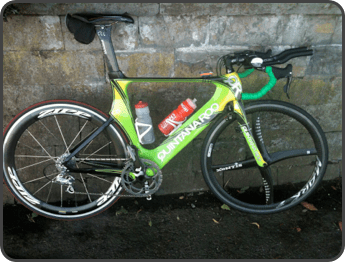
The only remaining issue was bar end shifters. Ideal for racing but when this is my bike for all my riding (it has been for several winters now) it would be good to not have bars ends most of the time. Clearly electronic shifting is the answer but it’s expensive and I’m on campag so not an option.

Instead with this final change I decided to try out including STI Shifters and then re-cable for bar ends. I’ve bought some dia-compe friction shifters and am very interested to see how they work.  This is how it looks now:

Posted in Bike Setup | Tagged | Leave a comment

My New Ride

MyNewRide.jpgWhat a great way to finish the week. A beautiful morning, out early, no traffic bombing along on my fantastic new bike heading to complete all my weekly targets. Swim 20k (done Fri with 22k), bike 400m (done today with 402miles), run 50 miles (done today with 52 miles), gym 4hrs (done Fri with 4.3hrs) and total hours of 40 (done today with 42 hours).
It’s been a while since updating this blog because I’ve been so busy. I’ve been doing a lot of coaching work with keys races for many of my athletes together with some new athletes coming on the team. I’m in my Kona build which means around about 40 hours training a week and on top of that I’m in the process of moving all my training into a new database. Moving the data is the easy bit building the database is taking time especially as I can pulled in realising all the cool stuff I can do.

Todays ride was so much fun I felt I had to write about it. I received the frame a few weeks ago and had gathered together parts to build it up. I did the majority of the build myself but some parts together with the final tuning up I left to Brian at The Bicycle Chain. Jo and I are very lucky to have such a great bike shop within a couple of minutes of home and Brian did a fantastic job on the build.

As soon as I got on the bike it felt awesome. It could be partly just having a new bike but it’s possibly the nicest ride I’ve experienced. Out of the saddle it feels rock solid and as stiff as you’d like. I did my standard fast TT route and there’s a particular corner that I know I can take without the brakes but normally I only just exit inside the centre white line… on this baby I had feet to spare.

POSITIVES

This bike addresses several of the issues I had with the P3C. The main one being bottle cages. The P3 has only one – this meant I tried out endless solutions – rear mounted bottles (never liked them and having used them for a while still don’t), big bottles between the aero bars – don’t like them. The straw annoys. Speedfill – still annoying strawer but pretty good and may use it. Here I have two bottle mounts to can just go all traditional with the addition of a bottle between the aero bars for gels.

The seat mounts to the post very neatly making for easy adjustment though one of the grub screws has fallen out which ain’t ideal. Seems OK with three. A big bonus is a saddle bag fits behind the seat which I never managed with the P3.

The frame is cool looking – always helps. Also it allows for a pretty agressive ride which is just what I want.

All the internal cable routing is super easy. This gives me the option of re-cabling for bar end shifters (more on this later).

The adjustability of the seat means I can easily shift it to a more road position when needs be (more on this later too).

I’m a believer now in the BB30 bottom bracket. The cranks on this felt absolutely rock solid. £200 SRAM crankset compared very favourably with the top end Record crankset on the others. I’m wondering whether I can get a 55 chainring for it so I look like a real animal !

NEGATIVES

Not a huge thing really but the rear brake is pretty poor – very soft and very difficult to adjust. In fact, I could get it to work very well at all but Brian did ! Also – I couldn’t run my front training wheel as it rubbed against the brake. Not had time to check but may just need a non winter tyre on. These are only small niggles but if you have to live with the bike and maintain it yourself they can add up. I think it’s just part of the deal with top end TT bikes though I don’t feel the tolerances need to be so tight.

MyNewRide2.jpgSET UP

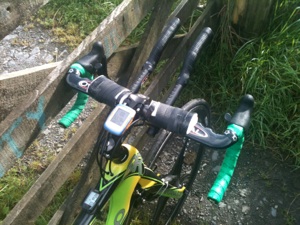
This gave me a chance to give a go at my ideal set up. I had planned to do a full background on how I got to this but I have to get a train to my sisters so I’ll keep it brief and do another post next week on it. As this is the bike that I will be using solely for the next 5-6 months I wanted something I could race on and train on. This means drop handlebars with a nice “clip on” system. I’ve gone for Oval bars that have flat tops. I’ve mounted aero bars using their “Under only” face plate. Then I’ve fashioned my own elbow pads direct on the bars. This felt really good today. It does mean I have my shifting on the levers but it didn’t feel too bad and  I will probably race like that at Kona. I’ve bought some Dia Compe friction bar end shifters and the plan is to try re-cabling the rear mech for Busselton. The current set up means I can easily completely remove the aero bars and ride this bike like a road bike.

This bike felt superb down on the drops, on the hoods, on the tops and on the aero bars. The latter will still take some tweaking to get it right (I’ll cover this in the next post). For a first 95km ride I can’t really ask for more.

Thanks Quintana Roo for a great machine.

Posted in Bike Setup | Tagged | Leave a comment

Learning To Barefoot Run

LearningBareFoot.jpgIn the past 6.5 weeks I’ve run 282 miles, all but one run of ~18 miles has been done in my Vibram FiveFingers. They are looking a little worse for wear now two toes have a puncture repair patch on them, one on top of an old one. I really must save up and get myself a new pair.
It’s been a slow build up to thisa point but about 7 weeks ago some tipping point occurred where I just didn’t want to run in normal shoes anymore. It was way more fun running in the FiveFingers. Strictly it’s not barefoot but I’m using the term for minimal running. The running just felt more connected more natural. I’ll admit I was slower. It was something I wasn’t very public about but it was pretty clear that my pace was slower in my Vibrams. it was especially the case at the start of runs. However, it felt right, it made you start slow and speed up as you got warm. There was no hammering out the door.

I trusted to a firm belief that this was the right way to run. When you hear things like “he’s a natural heel striker” it really doesn’t make sense. If it’s something thats done with shoes on then it’s not “natural” unless that person was born with shoes. I find it difficult to imagine anyone “naturally” landing on their heel when running if they have no support (ie barefoot). I found myself running slowly but comfortably, rapid foot strikes, mid to forefoot is how it felt. I was not concerned about pace just running and enjoying it. I certainly found that I tired less, more regularly feeling strong at the end of the run.

In the gym I’ve found that my strength at calf raises has increased. not surprising really. I’ve been working on that and together with more forefoot running it seems it was bound to happen.

So last week I did this 18 mile run in racing flats ( more on why later) and completed it in 2:20. Yesterday I went out in my vibrams and did it in 2:16. The last hour of that running being the fastest and I felt strong. I finally felt like I was running fast in vibrams. What an awesome feeling. I still started slow but it’s now for a shorter period. If you saw me run from my house down the road you’d be unimpressed but if you saw me a KM later through the park I’d be running well.

One the reasons running in vibrams feels so good is that you have to think about what you’re doing. You can’t just go putting your foot anywhere. Normal shoes / running shoes just remove your from that connection with your environment probably making you unaware when you’re doing something thats doing damage. With vibrams you have to place your feet and if you get it wrong you know immediately and react surprisingly quickly. Hit something a little two pointy and I’d do a quick step and minimise the pain. This reaction seems to improve. It means on rougher ground you adjust your stride much more which I feel helps reduce the stress of running. This is very similar with fell running. This connection and having to be aware of where you’re putting your foot does have it’s downside especially as you adapt to this type of running. In the past few week I had two such occasions:

First time was on my long run two weeks ago. I was on the towpath doing my long run when I hit a small stone which produce a pain under the ball of my right foot. It felt like it was bruised.  I completed the run but took the next day off running then had to do my long run the day after in normal runners. That felt OK and was good to do just in case I have to run in trainers at Kona. However, that run felt much more draining in my legs and as I ran I just felt I should stick with the vibrams and if it’s uncomfortable just not run. It’s my body telling me to rest. This I did and a couple of days later I was back running.

The second occasion was taking my bike to the bike shop. Just walking in my vibrams I managed to bash my little toe on the edge of a display unit. Boy oh boy it hurt. It calmed down and I later went for my run. 30 minutes of no discomfort then enough there to stop me running. That night and the next morning it was so painful I was limping and walking very slowly. At swimming the next day, Mike mirrored my thoughts when he said it might be broken. It was that painful. Then that afternoon I was out running and it felt perfect. I’ve not had the slightest pain since ! If I’d not experienced this myself I would never have believed I could have gone from that much pain walking to no pain in such a short period of time.

Running minimalist has given me the joy of running back. I don’t care for what people tell me the research is. I can’t be bothered to go checking if there’s been “no research showing supportive shoes cause injuries” or vice versa or whatever. We’re so influenced currently by “research” that we switch off from common sense. If an “expert” tells us there’s no research supporting such and such a thing how can we challenge it ? We’re not the expert, we’re not taking the time to look through it all. Who’s funding the research ? In this capitalist society we need a profit and since there’s no one out there manufacturing and selling feet I’m guessing most funding is supplied by those with a vested interested in a particular outcome. Remember – there was a time when there were lots of experts with lots of research telling us all that the world was flat.

For me this is logical but you don’t even need that … it’s a very simple thing to try yourself. Just remember though that since the moment you could walk you were encouraged to wear shoes with support so it may take some time to get back to your natural state. Just take your time and decide for yourself.

Posted in Barefoot Running | Tagged , | Leave a comment

More Day To Day Motivation

motivationI respond well to routine and find once in a routine training becomes so much easier. A little like auto pilot you know what you’re doing each day, there’s  a rhythm  to it. This is one of the first things I agree with my athletes – a standard week of training that can be achieved week in week out. This rhythm and routine also has the added  advantage of fitting in around other commitments (which tend to be regular) and love ones start to work within the routine (sometimes without even realising it) which reduces the stresses on family life. I remember when I was working regular hours people would not organise meetings between noon and 2pm because they knew I liked to run … I’d never asked for this and was always willing to skip the run but no one ever made me make that choice.

Selecting that week of training that can be repeated week in week out can be very difficult. Expectations of what we can achieve in a week tend to be skewed towards the bigger better weeks you’ve done in the past that dominate your memory. A training diary helps so much here as you can get hard evidence of this. Over the years I’ve always had in my mind 15k swimming a week which I think came about from the 3 squad sessions I could attend in London. In practise this was not as easy as I thought so my standard week started to be based off 10k a week. This week should be conservative so you can hit it … it’s good for moral.

It being achievable and repeatable helps get you going each day. Especially once you’re a few weeks in meeting (or bettering … lets not go there) last weeks training for that day / session helps get you out the door.

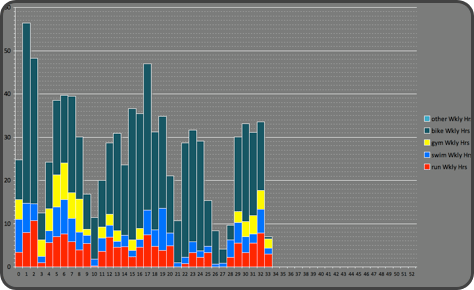
This has been key for me these past five weeks as I’ve got back into the routine. I know I can do 40, 50 or even 60 hour weeks but my experience that this can never be sustained for more than a few weeks. However, for me high 20 low 30 hours is very achievable. My first target returning from a big break after the European Long Course was consistency. Consistency is key as far as I’m concerned. In my experience it far out weighs big weeks then small weeks. So hitting 30 hours was the aim for 5 weeks then a few bigger weeks before tapering. The graph above shows I managed between 30 and 34 hours every week. Hitting 30 hours tends to be pretty easy as long as I’m focussed. It allows for easy days and the odd missed session. To give an idea of how it breaks down. Most weeks I did the following:

  • 13 hrs – 2 x long ride
  • 2.5 hrs – long run
  • 4 hrs – 2 x gym session
  • 4 hrs – swim across 3 or 4 sessions.

The remainder was made up from extra running / extra biking depending on the week.  The timing of this has worked great for me as it’s allowed me to focus on other things as well. This time of year is quite busy with many of my athletes having their key races. It’s good to have the extra time available to focus on them. It’s been a pretty successful few weeks for them and I’m confident it will continue in to this weekend. I’ve also had time to sort out my bike and work on building a database for all my training data.

It’s been a funny period though as I’ve felt I’ve been dossing. I’m used to hitting really big weeks and when I’m not it feels like I’m wimping out, it makes me feel like I’m not getting fit … it can hit my motivation. The steady rythm though just helps and after hitting the first week of 30 hours I manage to get myself up and going just to keep the chain unbroken.

motivation2.jpgAn example of how I motivate myself day to day is my approach to gym sessions. I have a few rules I follow:
  1. My target is 20 reps
  2. Once I hit 20 reps I increase the weight
  3. I do 3 sets on each exercise. The number of reps achieved is the minimum of the first two sets, I view the third set as a ‘bonus’
  4. For each exercise I score +1 if I’ve improved, 0 if same as last time, -1 if I’ve decreased
  5. Improved means more reps or more weight.
  6. More reps means the min of the first two sets with the proviso the total number of reps across all 3 sets has to be more than before for it to count. So say I did 12 reps x 3 the previous day then 13 x 2 and 11 reps on the 3rd counts but 13 x 2 and 6 doesn’t

Complicated ?? Sure is BUT thats part of the point. Every single exercise has focus to it, a reason to push further. The total score is used for me to determine the RPE for the session. The picture is my training diary… I even get satisfaction out of filling a page like that ;o)

Posted in Motivation | Leave a comment

Day To Day Motivation

Motivation--1.jpgMost of us have goals. I almost said all of us have goals but thought perhaps some people don’t. When it comes to Triathlon goals there’s a lot written about goal setting and how appropriate goals help motivate us. Mine are:

  1. PB at Kona
  2. Better than 3rd in AG at an Ironman
  3. Win my AG at an Ironman
  4. Podium in AG at Kona
  5. Sub 9 hours
  6. Win AG at Kona

So … a mere sub 9 win in AG at Kona would get them all ;o)

How does this translate in to day to day motivation. It’s so easy to say and believe that this next session doesn’t really matter. There’s plenty of time and what difference will missing one session make ? Here are some of the things I use:

1. Autopilot.

Switch off your mind, don’t think about it and just get on and go. This is my regular method for getting up for swimming especially if I know I won’t have had enough sleep. As I go to bed I tell myself I will get up as soon as the alarm goes and get out the door. Invariable this works. Before I’ve had my first thought of the day I’m running to the pool and once running there’s no backing out. I’ve used this the past 5 days whilst I’ve been up at my sisters. I’m on the sofa which means I’m last to bed (post midnight often) and first up (latest being about 6:30am when my nephews decide to jump on me).

Switching off the mind is also useful in races. Sometimes it’s good to be able to go on autopilot – just get on with the planned pace without your mind worrying. It’s like being in the moment. This saves mental energy for later when you’ll need it.

2. Adjust

If things don’t go quite right don’t just write it off – adjust and adapt. Often when a day starts off off plan my first thought is to write off the whole day. Resist that thought and reset the plan. This weekend saw a classic for this. My weekend was planned around collecting my bike on Friday. On the train to the shop I got the call to say it wouldn’t be ready. My initial reaction was my weekend was screwed. I let that thought have it’s time and moved on. It actually provided a opportunity for some nice running in the Surrey Hills. I switched my goals for the week to make it run focussed with less biking. This means I can finish the week on a positive note.

3. Statistics

I’m sure this won’t work for everyone but I track all sorts of statistics. Things like weekly averages, comparisons to previous years, weekly minimums and of course Eddington Numbers. This provides very formal intermediate targets. Something you’re advised to do with goals is have intermediate ones but this rarely translates to day to day goals. For me I use stats – most days there’s something I can do to move myself forward towards a statistical target. An example this year is a Weekly Bike Eddington number target which got me out for light spins on the bike on several occasions post the ETU long course when in the absence of this I would almost certainly not have got out the door.

By way of example the following would increase one of my Eddington Numbers tomorrow:

7 mile swim ! / 100 minute swim / 152 minute run / 107 minute bike / 21km run / 54 min run / 147 min training day

Some clearly easier than others.

4. Meet someone

If I know I’m not feeling motivated, or won’t when I wake up, I make an extra effort to arrange to meet someone. If I’m meeting a group I tend to try and be leading the ride so I have to turn up. Alternatively, arrange to meet a single person so you’d be letting them down by not turning up. This weekend I used this method, arranging to meet one of my athletes on Sunday. It proved highly motivational for both of us as it turned out.

5. Remind yourself the little things matter

It’s the small decisions you make day in day out that add up to great performance. Remind yourself of that when you think that this next session doesn’t matter. If you did an extra 4 lengths at every swim session that can add up to 300m a week, 1.2k a month, an extra 53k per year, 200+k in 4 years. It may not seem like a lot at that one session but if you make that right decision every session then it could be the difference in a few years time. This was a challenge I put to Jo once and I took on myself – when you

Posted in Motivation | Tagged | Leave a comment

Barefoot Running

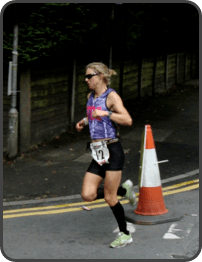
BareFootRunning.jpgIt was sometime the week before last, it didn’t seem important at the time, but now I guess it was. It was the last time I ran in ‘trainers’. Since that day every run till now has been in my Vibrams. I currently cannot see be going back to trainers. I feel so strong and relaxed running in them now. It reminds me of how I feel when I ride fixed wheel. There’s a feeling of connection, a feeling of control and definitely a feeling of using muscles right.
How did I get to this point ?

Looking back I realise it started way back in my late 20s early 30s when I went through a period of not being able to run and had 3 surgeries on my right knee. During that period I distinctly remember reading about some research being done into the lack of proprioception from the feet due to wearing supportive footwear. They came up with textured insoles that helped the foot feedback to the brain what was happening as it hit the ground. Funnily enough when I got the original Nike Frees they had textured insoles which are great but for some reason they seem to have stopped doing them. Anyway… this was like a Eureka moment for me. Thinking about it now it was probably the start of my more free thinking that ultimately lead me to massive changes of some pretty set views and a general questioning of “conventional wisdom”. I won’t get sidetracked with that.

At that time I made the decision that when I could finally run I would run in unsupportive racing flats. Yes I took the textured insoles a little further and decided that the more feel I got for the road the better. This was about 10 years ago.

Before getting in to triathlon I did loads of fell running. Interestingly enough fell shoes tend to be pretty unsupportive – they realise that big soles just lead to even more sprained ankles. Despite that I sprained my ankles multiple times and on one occasion managed to sprain both (though I didn’t realise one was because the other was so bad) and ran the second day on them. The physio showed me how to strap them. He said the strapping isn’t for physical support it’s to increase the proprioception by tugging on the skin in more places when the ankle gets pulled over. Interesting that.

During this period and into my triathlon racing I had no running injuries despite some pretty big volume. Fell runs of 10+ hours regularly and multiple 100+ mile weeks including one period of 3 weeks where I did over 100 miles every week. All this in unsupportive shoes. In fact, I went one further with my questioning. I decided not to replace shoes until they wore out. Seemed sensible to me. Why believe a company telling you to replace their product after a certain amount of time irrelevant of how they look.  Seems good commercial advice. As a result I spent even more time with even less support. This also appealed to the Yorkshireman in me – not only are racing flats cheap but they really last if you only replace them when they have holes in them.

So… come last year and I snap my FHL tendon. I’ve said I was injury free from this approach so I must address this injury as many out there will simply lay the blame on my running and my use of unsupportive shoes. Why wouldn’t they… a multi billion dollar industry is pushing the view that you need supportive shoes. This injury is INCREDIBLE rare. In fact, it’s unheard of other than through trauma or ballet dancers (standing on tip toes puts a lot of stress on this tendon). It is incredible unlikely this was snapped merely by using it. The most likely cause of this is some trauma in my past I wasn’t aware of. I’ve of course thought this through lots. Finally I remember an occasion when I was a teenager dropping a dumbbell direct on that toe… I do wonder. The other possibility is that I have a genetic tendency to weak tendons. Either way I think this injury was not due to my choices in running footwear.

Whilst sitting in a cast with nothing to do I read “Born To Run”. Reading that was like first reading The Paleo Diet. The penny dropped. Things weren’t so complicated. Ignore the advice thats bandied around and just take one bit of advice – do what is natural. Millions of years of evolution can’t be wrong. It’s quite arrogant to think in the past 30 years big business has discovered something better for our feet than natural selection did. So I got myself some   fivefinger shoes.

It seemed a good time to start wearing and running in them as my volume would be very low. I was effectively starting from scratch. Problem was I was subconsciously protecting my FHL tendon and causing compensatory injuries. To fix this I had to use an insert (hopefully temporary) which meant back to the racing flats. Since that point I have walked in Vibrams or bare feet probably 99% of the time. Running has been a mix. In Christchurch I would run in vibrams regularly to and from the QEII centre (about 3km each way). I also suspected one problem was lack of calf strength so I worked on that in the gym.

A year on from starting back to running and my feet feel so strong and now I am running all the time in vibrams. I’ll keep you posted if I ever go back to trainers.

Would I advice this to others ? If you’re my competition then definitely not. You don’t want to wear these, they’re terrible. To everyone else definitely. Just take it slow as your legs and feet adapt. You need to give it time and for that I think you need to be convinced. Think this through and ask questions. When considering the answers think carefully as to where your answers are coming from. So much advice is just out there … no one really knows the source but repetition gives it strength but repetition doesn’t make it right.

Here’re are some of my layman’s views on it that may make you think

-does it make sense to have support under your arch ? Any engineer worth their salt or even a kid with GCSE Mechanics will tell you that an arch is strong by not having support under it. It distributes the weights to either end. In the case of your foot that will be heel and ball. If you put support under it some forces will be applied at each point … ever wonder why runners get stress fractures ? I’m a layman but it seems to me that applying forces through the arch to bones not designed to take them would not be wise.

-Pronation. It’s only possible if you wear a supportive shoe. So when people wore these and started to pronate and got injuries what advice did they get (from the shoe shop / shoe company) – it wasn’t stop using our shoes and go back to your Dunlop Green flash. No, it was buy this more expensive shoe from us to fix it. Great business model.

-heel strike. Is this natural ? Try running in bare feet a little – you can’t heel strike. Ever looked at the complexity of your foot and wondered why ? Could it be some awesome shock absorber that’s just completely bypassed if you heel strike. Is the only reason you can heel strike due to the padding on the heal of a running shoe.

-Fore foot running. Is this the natural way to go ? Why do shoes promoting stick a heel on ? This surely just makes it harder to fore foot strike.

To finish … did anyone notice the puncture repair patch on the toe of one of my vibrams ? Seems to be working well.

Posted in Barefoot Running | Tagged , | Leave a comment

Ironman UK Supporters Report

UKSupporters.jpgLast weekend Jo and I drove up to Bolton bright and early on Friday to arrive at the Hotel in time for Breakfast. We’d got in to the race hotel and I must say it’s the best race hotel I’ve been in. It was a combination of things. It was right next to the race start, plenty of parking, large spacious rooms and most importantly very friendly and super helpful staff. Nothing was too  much. They had a buffet dinner each night with the competitors in mind – yes that meant pasta and yes it meant we didn’t use it but I bet 95% of those racing thought it was ace. To top it all from 2:30am they had breakfast on race morning. Not  just some cereal and a toast machine they had the full on buffet breakfast. I enjoyed a fuel up at 4:30am before heading to the race start.

I’d made sure I’d got some  decent training in the previous two days not only to ensure I didn’t feel any pressure to train on race day but also to give Jo space to just relax. It meant I’d had two long wet days in the saddle and come to the conclusion that in all my extensive riding around the UK this area has by far the worst drivers for cutting (very) close to cyclists. It happened so many times and it was always regular cars – white van man was unusually courteous and thoughtful round here.All confirmed by Nick Rose ( a local) on race day. It’s not somewhere I will be coming back to in a hurry to do cycling. The best riding I found was up north of Preston and around the Ribble value – unfortunately from the race venue it’s quite a ride to get there.

Back to my breakfast… reading the sunday paper watching the nervous athletes and loving it. Not often you get to enjoy the buzz without the nerves. I wandered down to the swim start. Not the best one for spectating as the start is well in to the water and you don’t really see a huge amount. I managed to get the perfect spot for a photo of Jo as she ran out only to hit the on/off button instead of the shutter as she ran through. She’d done a 58 minute swim split and looked very happy so didn’t bother to let her know the leaders came out in 43 minutes indicating the course was several hundred meters short. She was about 8 or so minutes down on the lead girls which was probably about as expected.

Having seen her out on to the bike I had to peg it back to the hotel. Text her mum and sister and hop on my bike. To get to the main loop on the bike without riding the course required a slightly longer route so I put my foot down to get there. At this point Bella was pulling away but she’d halved the deficit to 2nd and 3rd. Back on the bike to peg it over to another point on the loop. This defined the bike course for me – get to a point before Bella arrived. Time the gaps, let Jo know, text Jo’s mum and sister on progress back on the bike to get across the course before Bella arrived at that point. This involved Balls out 20-30 minute efforts as Bella was pulling away so I had less and less time to make it. This was the toughest bit of spectating since after the first check Jo was slowly dropping back and there was nothing I could do about it. By the end of the bike her gap to 2nd and 3rd was the same as at the start of the bike but Bella was 24 minutes up.

This meant that Jo was already close to the 5% rule. The game wasn’t over but did she believe that. I managed to get to the point a few miles in to the run and she’d already closed a few minutes on Bella and third place. Yvette was running just as well as Jo. Just looking at them running you could tell Jo should be able to get 3rd and would close on Bella. I told her this and said “this race can still be great”. I wanted her to realise that she was still in a position to end up with a top race performance.

Now it was a pleasure to support. Jo was running so super strong and she was gaining on everyone other than Yvette (who chased down Bella for the win). Her sister and Andy were there and I bumped into Nick Rose and got chatting with others. They all helped with splits so she knew exactly where she was. She moved in to 3rd place at about halfway and was closing on Bella but unless she walked she would run out of road. Bella didn’t look in a great place but she’s one tough cookie and kept moving at a reasonable place to hang on to 2nd. Good on her.

3rd place in her first season as pro – superb. There were 4 pro slots and we’d been told the split was likely to be 3 male, 1 female putting Jo just out of the slots. As it turned out the split of males to females that actually started was about equal. Jo was on the podium when they said there were 2 slots for women. I went completely bananas and she looked pretty damned pleased. Kona as a pro in her first season…. I’m proud as punch.

Posted in Race Supporting | Tagged | Leave a comment

Some Proper Time Off

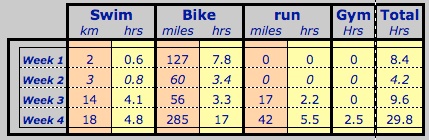
ProperTimeOffNo it’s not an Eddington Review but for lack of a picture for this entry I decided to display some of what I’ve spent my time doing these past four weeks. Only a small proportion of that time but it has meant all my Eddington numbers are now imperial and metric. In my head I think of this as “Training By Numbers” – just each day try and contribute to at least one Eddington Number.
It’s been a long while since I’ve blogged. Partly intentional. I’d planned a break after the ETU Long Course. I’d realised that it had been non stop since recovering from my injury and felt it was essential to just down tools for a period. A little luck and a little judgement meant that I completed the purchase of my new house in Taunton the Wednesday after the Europeans. There was an initial calm before we moved anything in and then it has been non stop.

Life has been so easy with everything in one bag. With all my stuff I suddenly couldn’t find things and I needed to get things sorted. I know what I’m like my mind just couldn’t focus on training until things are organised. Charity shops got probably 5 times the amount of clothing I’ve been living with these past 18 months and I just hadn’t realised how my cycling jerseys I’ve amassed. I would place money on me never ‘needing’ another cycling jersey in my life. I’ve even been DIYing ( not sure what my dad would have thought of that) – I’ve partially boarded the loft and have just got all the wood to finish the job – have to decide when to fit that in.

On the bike front news has been as good as it could be. Not only is it looking likely that my frame will be replaced under warranty but uncertainty prompted me to follow up on a discussion I’d had with the QR rep at Kona last year. He said “hassle me” to get  a bike from him. Well I did and I should be getting a QR CD0.1 frameset in the next few weeks. Exactly the same colour as Jo’s much to her horror. I’ll try and sneak a photo of us both on them in EverydayTraining kit – it’ll look great.

The title says proper rest. What does that mean for me ? This is the first time I’ve really taken having a break seriously. Here are the stats:

ProperTimeOff1

Up until this point I’d never done less than 10 hours in a week and I had it as a little to go the whole year that way BUT I came to my senses and seriously downed tools. The first week was big riding purely because of social stuff – riding with European champions Roger and Roz immediately after the race and then a social ride with Rachel. The following two weeks found me only riding because of the pursuit of an Eddington Number – not divulging it until end of the year (assuming I manage it) though the astute amongst you may be able to work it out. This motivation to at least ride a little paid dividends when i got back in to training this week. I did zero running for two weeks – completely intentional. Give my foot a chance.

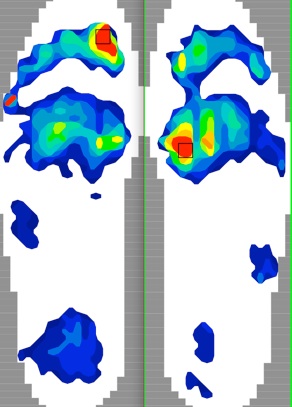
During this rest period I had a visit to Profeet to have pressure analysis done and insoles built for my cycling shoes. They did an excellent job and so far I’m pleased with the results.

ProperTimeOff2I found this incredibly interesting. The left foot is the one that had the surgery. The most pressure is going through the big toe. My consultant’s comment was “the tendon is clearly working”. I wonder whether this pushing with my big toe is what put too much stress on the tendon in the first place. Hopefully these inserts will get me putting the pressure through the ball of my foot. Once I’ve done a decent amount of cycling with the inserts I’ll be back to see Jonny at Profeet for a reassessment. I fully recommend going and seeing these guys.

I’ve also been spending time thinking about the set up of the QR. I’m sorely tempted to go with integrated shifters rather than bar end ones. This bike will be my only bike for 5 months this winter and wonder whether the trade off in races verses training of this set up would be worth it. Answers on a postcard please.

This week I’ve got back in to training and I feel absolutely full of beans. It’s great. I’m motivated, I’m feeling good and I’ve loads of fantastic new roads to explore. The riding round here is truly awesome. If every direction there are tonnes of minor roads to explore. Hills – just a few – Quantocks (2 miles away) then there’s Exmoor, The Brendon Hills, The Blackdowns and further afield Dartmoor. There’s flat riding on the Somerset levels and then rolling terrain if you head into Dorset. Swimming appears to not regressed at all. The only downer here is no squad so I’m in a public pool each morning. It means a lot of steady state. A 1:11 plus seconds 5k including warm up confirmed to me I’m still strong. The odd set of 200s off 3 minutes coming in sub 2:50 (33.333m pool) comfortably also helped my confidence. As for running, it was a struggle initially but it’s coming back quick.

I managed to enter Ironman Austria so my coming year is pretty mapped out: Kona, Busselton, Wanaka, New Zealand, break, Austria. For now the focus is on really building up my base. Depending on how that goes I’m may just continue with that sort of training right through to Kona. I feel I’m back in the saddle now so more regular blog posts should become the norm again.

Posted in Training | Tagged , | 1 Comment