Ironman Wales Race Analysis 2013

Race Report here.

I’m disappointed with my race. Despite that I am incredibly satisfied with it. I’d prefer to never have a race like it but battling through adversity in an Ironman provides some of the most amazing experiences, however, it’s happened rather too often over the past few years. Having reflected for a day there are a few things it’s demonstrated / confirmed to me:

  1. The race isn’t over due to a bad start
  2. Pacing the bike so you’re strong in the final third puts you in a great frame of mind for the run
  3. Your perception of how you’re doing during the race does not always match how you’re actually doing.
  4. There’s no hiding from lack of run training
  5. A big part of my poor run performances is due to my head.
  6. It’s all about the run

I was pretty happy with my preparations for this race. I should caveat that – happy given what has happened. It was far from what I’d hoped and planned at the start of the year. I correctly scheduled my racing having realised I benefit from routine and early summer Ironman racing just throws that routine off. For a few reason’s I didn’t maintain that routine, the first was really out of my control the other two I could and should deal with

  1. Spraining my ankle at the end of April stopped me running (more or less) for two months. To that point my running was on a roll. It was bad luck. I’ve sprained ankles loads of times when I was racing mountain marathons and on one occasion sprained both but never one as bad as this.
  2. Rather than an Ironman I went and attempted the Welsh 3000s and spent 15 hours moving through mountains and pretty much went for two days without sleep. This left me physically in a bit of a state but more importantly it removed my enthusiasm for training for several weeks.
  3. In the middle of my build I had a rest week which coincided with the start of the swimming club break. I thought this was a good bit of scheduling but in hindsight given the need for routine it was a bad choice. In future I should schedule it so that the first week after it has squad swim as that provides the structure to get me back in to routine.

SWIM

A very disappointing swim.  Outside of Kona, this is my slowest swim in over six years. This year my swimming has been improving. I did a 400 PB early in the year. The key to my swimming is consistency. This works well when I’m in Taunton but on camps when open water is the only choice it gets knocked back. I’m not sure how I can avoid this. Certainly our camps in the Pyrenees are of huge benefit to my biking but leave my swimming well off and then the timing for this race is almost perfectly bad in terms of the swim squad summer break. This was exacerbated by there being no Level 2 coaching course run. Last year during the break a coaching course was run and they needed swimmers in for  2hours each afternoon so I ended up with a big volume swim week.

This only partially explains my swim split. My first lap was at 1:25 pace and the second at 1:31. That second lap is woefully slow, even if it was non wetsuit swim it would be slow. Clearly the swim route didn’t have the advantages of last year (either short or strong currents). My feeling is that the final turn buoy had been pushed out a bit. This still doesn’t explain it. Looking at people I know and the top pros I do seem relatively slow. I’m not normally 9 minutes behind the leaders.

A big factor was how cold I got. Now, I’m not sure of causality here. It could well be I got cold because I didn’t go hard (fast) enough or vice versa. I’m been trying to figure out why I got so cold. I’ve not come up with a reason that seems to make total sense. The water was clearly warmer than in other years though I reckon the air temperature was lower. Some contributing factors:

  1. I got to the swim quite early to ensure a good starting spot
  2. I warmed up. This probably, in hindsight, was a bad decision. I was warm enough in the water but then had 20 minutes or so stood getting cold. It meant I started the swim cold
  3. My wetsuit is a bit worse for wear. It’s served me well over the years and is comfy but it now has several small holes in it and the legs are cut just below the knee. I do wonder whether this meant that cold water was seeping in throughout cooling me down.
  4. I do wonder whether I was slightly ill but didn’t realise it. Not really convinced by this as I feel ok now, two days after the race so it’s not like it was I was starting to come down with something.

None of these really seem to be able to explain it. Whats most strange is that the water was a lot warmer than previous years. Perhaps the third reason is biggest contributor, I certainly won’t race in that wetsuit again, but it’s probably a combination of all the first three.. Two years service is enough. As has been pointed out to me I’m in a lucky position in that despite having a very poor swim I still was sub 56 minutes and came out 2nd in my age group.

T1

Notes for next year – stick just some slip on shoes to put on. My hands and feet were so numb and I was shivering that getting my toes in vibrams was a nightmare. For that 1k run just something easy to get on that protects your feet from the ground is enough. I am very pleased I had the presence of mind to leave my wetsuit fully on and swim cap on for the run in. I hoped it would warm me up. Given how cold I was as soon as I pulled my wetsuit down in the final 100m it was clearly the right decision.

Ahead of time I’d considered wearing my arm warmers under my wetsuit. I decided against it as I felt they may prove cold if I started the bike with them wet. Since the race someone tweeted me that thats what they did at UK. I wish I had as I had a nightmare getting them on. Apparently Jo was shouting at me in transition not to bother with them as she could see what a mess I was making of getting them on. The other thing I should have done was wear by Gore Next To Skin vest on under my Tri suit. I did this at Wimbleball and would have this time but stupidly didn’t even think to pack it.

BIKE

This was a mental battle for the first hour. I was so cold, I couldn’t think of anything other than getting warm but there was no power to work with to create heat. When the sun came out and I was in it I slowed to try and warm up. I was so close to calling it a day as people were just streaming by. To give an idea Pembroke is about 18km in and it took me 40 mins to get there compared to 30 minutes in 2012 and even in 2011 when then was a massive head wind it only too 33 minutes. Still, it’s only 10 minutes. Similar to a puncture. At the time though it feels like you’re going backwards. It also felt I was suffering right through to Angle but looking at it in hindsight from Pembroke on I was holding similar pace to previous years. I passed a friend, Paul, who had punctured and at the time I thought that he’s losing as much time as I did from being cold. I think this probably helped me re focus.
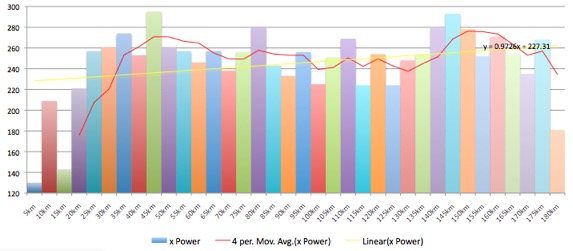
_powerwales2013

This graph is my normalised power for each 5km together with the 20km moving average. Looking in hindsight is very interesting as there are a couple of things that I thought had happened post race but before looking at the data which weren’t correct:

  • The length of time I was miles below my power. I felt it was most of the way to Angle ( until the drop down to the beach before Angle). In fact looking at the data I was pretty much ok (power wise) from Pembroke. This is verified by checking by pace against previous races
  • I felt that I was ok through the rest of that third (but I was actually going well. At the top end of my IM power range), I was at IM power in the middle (I pretty much was) and I really cranked it in the final third. I did but it wasn’t as dramatic a shift as I thought.

This shows that in the final third of an Ironman bike the effort level will feel a lot more to merely maintain pace. I felt there was a step change in my performance (following peeing on the bike) but it wasn’t actually quite as dramatic. This perception of increasing pace is skewed due to those around fading. In that final third I was flying by people on the bike.

It shows as well that though I have a power meter I still tend to ride on feel. I don’t find it easy to look at my power constantly but instead try and keep each 5k average within my Ironman power. Overall I’ve got to be happy with that bike ride. I was much better at keeping my efforts in check on the climbs. I’d noted, during practise on the course, that even in my lowest gear I was getting close to 300w on the climb. This meant no matter how strong I felt I made myself drop right down the gears and spin as much as I could. It’s shown that my bike form is where i thought it was. I’m quite pleased with the consistency of my riding once I warmed up and having the strength to crank it at the end, though it might not have been the wisest thing to do, it confirmed that my bike preparations haven’t been miles off the mark.

My normalised power for the ride was 257 watts which is the highest I’ve recorded. One caveat is that I think the quarq reads high compared to my Powertap. To give you an idea of this bike course – in 2010 my NP was 240w at Busselton for a 4:50 bike split, on Sunday 257w gave me 5:56!

T2

Pleased to say nothing to report. Fast enough. Felt positive because of strong finish to the bike

RUN

The run went close to expected. The great thing about Ironman is there’s no real faking it. If you’ve not done the work you’ll find out. I knew I’d not done the run work and it eventually hit me. It also showed yet again that it’s the run that really matters. Despite me being perhaps 20 – 30 minutes behind where I’d thought I would be it was still all to play for. A guy I finished the bike within a minute of went on to run in to fifth in my age group with a 3:21 marathon. There are massive gains for me to make by improving my running. It’s not like breaking new ground and PBs. I just need to get back even close to how I used to run and it would be ok.
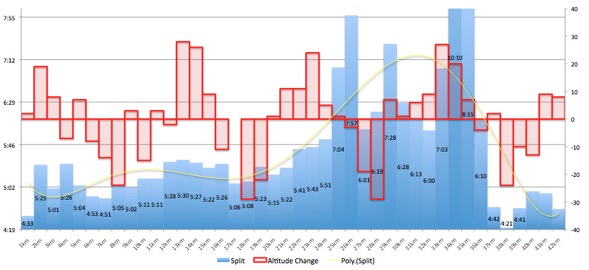
_runwales2013

The graph is my KM splits together with net height change. First note that the course was the correct length. In fact I reckon it was now at least 500m long !! I felt pretty bad running to start but got in to my running after a few KM. My goal now had changed to run the whole thing and keep it as comfortably as possible. The intermediate goal was to run the third lap well as thats where I’ve always fallen apart. Coming on to the third lap I focussed on this but towards the top of the main drag it fell apart and I was walking. The next 10k were torture. A big positive were the shoes I wore: Vibram FiveFinger Seeya – I’d cut off the strap so they were just slip ons. Not a single blister or rub. Perfectly comfortable with the added bonus that though they’re great for running not the best for walking so it helped keep a cap on my walking breaks.

As I approached the far turnaround on the final lap I decided to try and get something really positive out of this. I think it was prompted by two things – first seeing Tim Bishop cranking it for the age group win and second having a club mate behind who would catch me at my current pace. I decided I should test whether, if I was in a race for the win, I could really push the final 6km. What a great decision that was. I flew down the hill at one point seeing 4 min /km. I was passing everyone so quickly it was a thrill. It confirmed what I remember reading years ago – the discomfort is more or less the same whether you’re running fast or slow. I managed the final 6km in 28 minutes. It felt good to be running really hard for no other reason than because I could. I crossed the line absolutely over-joyed and really quite wasted. Not sure any one in the crowd would have any idea why I was running so hard. There was no one else in sight and there was no benchmark time as I came in in 11:07.

This has been a great boost to my confidence. Firstly it shows that a certain amount of my slow running and falling apart is in my head. It’s never nice to admit it because it’s nice to think of yourself as tough BUT when it comes to running I’ve just lost that mental toughness I used to have. I need to regain it.  Secondly, I’m going to note here for reference next year (yes I’m racing next year, even if I get to Kona. I’ve even booked my accommodation!)… next year I need to remember how it felt to just let the legs go and use gravity on those downhills. I think focussing on letting rip down those hills each lap will help an awful lot.

Posted in Race Review | Tagged , , | Leave a comment

Ironman Wales, Tenby 2013

Swim: 0:55:53
T1: 12:14
Bike: 5:56:19
T2: 2:28
Run: 4:00:22
Total: 11:07:16 (20th / 97th)

Race Analysis here.

I had my usual pre race sleep of waking about every 30 minutes to look at my watch. There were many torrential downpours which sounded pretty dramatic laid in a room in the loft. I kept positive by thinking “better now than tomorrow”. The rain had stopped by the time I went to transition at 5am, checked my bike and came back to the flat for a snooze. I felt more nervous than usual in the morning and couldn’t face that much food only eating a couple of toffee waffles with a cup of coffee. I thought that since I’d eat well the night before there really couldn’t be that big a need for too much food.

I walked down to the swim at 6:15, quick warm up and then I got right to the front line for the swim just beside a massive fella who was going to lift the tape. I chatted with him and established he’d lift it high and would make sure he wasn’t in my way. I felt cold and tried to keep warm by moving a little and shaking my legs.

SWIM (55:53)

The course had been changed slightly in the hope of reducing how rough the start was last time. There was  now a turn buoy (in theory to make sure you swim rather than run down the beach) closer to shore and in line with the first main turn buoy. Unfortunately it was in line for perhaps the right hand half of the field. For those lined up for the shorter line it mean about a 20m swim to a sharp turn. Sensible the Pros were allowed right up to the buoy for the start.

The horn going is always a weird surprise, the reaction comes first and the realisation in your consciousness that your racing arrives seconds later. It was very rough indeed. Pushing and shoving before hitting the water and then just no water to pull in. I swam water polo style and had to go across three people to get some water I could swim in. Wasn’t convinced this improved the start at all, in fact it was worse as there was no space to spread out, I think everyone in the field could race to that buoy as quick as each other.

After that turn it settle quite quickly and I find a nice rhythm. I was enjoying it. We turned to swim parallel to shore and I start to feel cold. Coming in to shore we seemed to go through a very cold section so that as I ran between laps I was shivering. This continued through the second lap and I remember coming in on the final leg and being surprised that there seemed to be a age group pack pretty close behind.

T1 (12:14)

I exited and was so cold. I was shivering. Got to my shoes and struggled to get them on as my feet and hands were so numb and I was by now shivering almost uncontrollably. I had the sense to leave my wetsuit and swim cap on for the run to T1 hoping it would warm me up. I still wanted a fast transition so as I approached I pulled the wetsuit down to my waist. I couldn’t believe how cold I was when I did that. I felt really upset and wondered whether they would let me continue.

In the change tent I sat and was shivering so much I couldn’t get arm warmers on. I had a helper who did his best. Not sure I spoke any sense. I noticed Jo next to me, I thought “odd”, I said something about being cold but only found out later what she’d said to me.

BIKE  (5:56:19)

The bike starts with a decent which just made matters worse. I was shivering and wondering whether I should continue. I looked at the clouds and thought if it rains now I’m well up shit creek. I was trying to ride to warm up but had no oomph! Also the first 20k are pretty fast making each decent torture. I was getting quite concerned as I wasn’t warming up. I was going slow as people flooded by me. I had a massive internal debate about pulling out. I wondered whether I was actually ill. Not sure why I kept going I seem to remember the thought of  a pint with friends after the race having not finished clinched it. Luckily the it didn’t rain and the sun came out in parts. I found myself slowing slightly when the sun hit me as it was so nice to feel some warmth.

Near Angle there are some decent hills which I think helped warm me. It also helped getting a little angry at people coming by on the no pass zone. I had slowed down to not pass and three people go by including one female Pro. The first guy start to pass me, I told him it was a no pass zone, he dropped back then decided to come through anyway straight in to the path of an oncoming make pro who shouted at him forcing him to drop back. I pointed out that was why it was a no pass zone. He then went by anyway. I found out later there was a crash on that section.

By now I started to ride better and the flood of people passing stopped as I started to move up the field. The weather was quite changeable with some heavy downpours. Luckily I was now warm. I was now hitting my planned wattage and I could see my average come up. Starting the second lap I managed to pee and that improved how I felt. I pushed on even more. Enjoying feeling strong. It seemed that I had worked my way fairly well up the field and was pleased to see there were not too many bikes in transition – more than normal but less than I’d expected.

T2 (2:28)

This was quicker than T1 ! Was keen to run

RUN (4:00:22)

I felt terrible running for the first couple of KM but those that passed didn’t pull away too quick so I knew it wasn’t too bad. I wasn’t in the race so decided the aim was to run the whole thing as controlled as possible. The first goal being to run strong in the third lap as last year it fell apart at halfway. I got in to  my running after a few KM and was really quite enjoying it. I got through to halfway still feeling in control and managed about 3km of the third lap before it fell apart. The walking started on the steeper hills and through aid stations. The third lap was slow. The final lap I managed to pick it up and as I start back down from the first turnaround I decided that I could get something out of this run by running the last 5km as if I was in a race for the win. See if I could do it. I flew down the hill confirming that the discomfort running fast didn’t same worse than the discomfort running slow, it was just different. I managed a 4:20 km and just kept going. It was fun as I was travelling so much quicker than anyone else. It was a good way to finish.

Writing this I am incredibly disappointed with the race but like the other times the race has been tough there is a real satisfaction it sticking at it. If I’d pulled out I would have been in a very bad place mentally for heading to Ironman Florida but now I am positive about my bike as the latter part of the ride showed I am riding very well at the moment. Similarly the final part of the run illustrated that a big part of my run performances is my mental toughness.

Posted in Race Report | Tagged , , | Leave a comment

Ironman Wales Preview

tenby-aerial-2013.jpg

I’m back in Tenby for my third go at Ironman Wales and again with the hope of qualifying for Kona. I say hope because based on the standard of the past two years I think I’ll be doing amazingly well to qualify here.

This year I made a point of not entering an early season Ironman since I felt in previous years it had dampened my momentum in training. Without a big race the idea was I would put together a big block of training through the summer and be in top shape for my first Ironman late in the summer. Did it work ? Kind of. Instead of a race I went and made an attempt on the Welsh 3000s at the end of June. It was great fun but 15 hours walking in the fells knocked me for six. It’s not just the weeks after of not walking properly down stairs, thats easy to deal with, it’s the fact it again removed my momentum. It took a lot longer to get my head back in to training.

I’ve always come to realise that I benefit massively from routine. If my routine is broken I can take time to get back in to it. For instance this summer I did a fantastic block of training which ended with a planned easy week when my mum came to visit. This also coincided with the swim squad summer break. The combination knocked my routine for six and I found it took a further easy week to get myself back in to it. Overall, though, it has been a good build. Not quite what I’d envisaged but good.

SWIM

Since moving to Taunton I’ve been so lucky in being able to train with a very good junior swim squad. I train with national medalists, british age group record holders and a young distance freestyler who’s improved massively this year through sheer hard work and determination – it’s really inspirational. The coach has a different approach to all my previous coaches. Not one for loads of drills, instead a real focus on feel. There is no doubt my swimming has improved. I think he’s slowly removing many of the bad habits I’ve developed since becoming a triathlete. Most importantly, though, is that I thoroughly enjoy the environment there and it provides great structure to my training week.

For this race, though, there’s some bad timing as they have a two week break in early August and then on return there is complete focus on skills. Long term this is good for me but specifically for Wales it means I do no real swim volume.  My coach has been fantastic in building sessions that create some time when I can do regular training alongside the time spent doing push and glide and specific freestyle skills. It’s certainly helped my feel for the water demonstrated by the 1:12s per 100 I was hitting on Tuesday, my last squad swim pre wales. However, it means I’ve averaged only 7km a week for the seven weeks leading in to the race.

I like to put down predictions. Based on how fast (or short) this course has been the past two years I reckon that still a 50 minute swim should be possible.

BIKE

I’ve been really enjoying my biking this year. I feel in better form than this time last year. What I find interesting is looking at my Training Stress Graph for the year:

_tsb-2013-09-05

The peaks in fitness are following my two Pyrenees camps – firstly the NGT camp in May and  then our EverydayTraining KOM camp in June. Back to back big days create a lot of fitness and it seems I’m able to shed the fatigue well. I was certainly riding very well after that. The problem is that to maintain that requires lots of riding. In fact at it’s peak I required something like 165 TSS per day just to maintain that fitness figure. Thats a pretty solid 3hr ride. Through July and August I had hoped to regain those sort of numbers but I just couldn’t manage it. It makes me think about the fact this is just a model and is not absolutely accurate. I feel pretty strong on the ride and the numbers I’m seeing are good. Here is my predicted performance graph:

_predictedperformance.jpg

I’ve been using a 10 min turbo power test on the aero bars. I’ve not continued these tests through the summer. I’ll be honest there was no particular reason for stopping. With hindsight I feel that this has meant the model hasn’t evolved and next year I plan to continue regular testing throughout the season. The performance graph shows only a drop off of 25w from it’s peak in 10 minute power and given the riding I’ve managed over the summer I feel I should be going OK.

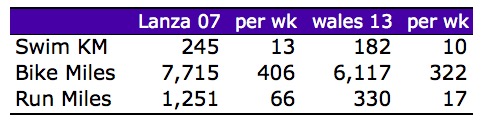
Last year I felt terrible in the first half of the bike which ensured I didn’t ride too hard. It resulted in the second half feeling really strong and hitting the run in a great frame of mind. As such I am keen to stick to my guns of not going too hard too early. Over the past few years I feel that in general I’ve gone off way too hard on the bike. I’m been thinking through why. I keep coming back to Ironman Lanzarote 2007 when I set off very hard on the bike and had a superb (probably my best) race. However, back then I’d done an enormous block of training without a single niggle or illness. Comparing the 19 weeks leading in to race week before that race to this we see:

_pre19weeks

We’ll come on to running later but looking at the bike I averaged over 80 miles more per week in the run in to Lanzarote 2013. Even more significant is the level of long riding I did back then. In 2007 I did 48 centuries (more than two per week) verses 14 this year. In 2007 I did 30 “over distance” rides (including 7 over 150) but this year 11 (only 1 over 150). I’m in good bike shape now but I can’t expect to be in the same sort of invincible form I had back then. The aim here is to be a little more conservative early in the bike.

So prediction – given forecast for some decent wind I think 5:45 would be a pretty solid ride. With conditions like last year I’d go with 5:30

RUN

I am a little disappointed with my run preparation for this. From the beginning of the year I had enthusiasm for running and by end of February I felt I was starting to run halfway decently. However a bad sprain of my ankle at the end of April really put the kybosh on that with the following 2 months covering less than 70 miles. Since then I’ve started pulling it back together with some long runs and solid paced runs. It’s coming back but I do feel this race has arrived a little early.

Comparing, again, to Lanza 2007 we see my run mileage is incredibly low. In fact, you don’t need a comparison to see that 17 miles per week for the 19 weeks leading in to race week is very low for an Ironman. The sprain has skewed that, in the last 7 weeks this year I averaged 35 miles which is a lot better but no where near Lanzarote. I need to get rid of this mental block for higher volume running.

Long runs is just as contrasting: Runs over 13 miles – 36 in 2007, 5 this year, over 20 miles 17 in 2007, 2 this year. The big positive for me this year is I managed an over distance run (for Lanza 07 I’d managed 4).

From this I need to not be too ambitious early on and I’m mentally rehearsing keeping pushing when it starts getting tough as it most definitely will. The training isn’t there to expect one of those amazing Ironman runs when you feel strong throughout.

if the course is correct distance I’ll predict 3:35 – thats on the basis of 5 min KM with a fade late in the marathon. If the course is as short as last year then 3:20 !

Overall this gives a prediction of:

  • 00:50 Swim
  • 00:09 T1
  • 05:45 Bike
  • 00:03 T2
  • 03:35 Run
  • 10:22 Total

Of course, predictions are rarely accurate…

Posted in Race Preview | Tagged , , | Leave a comment

Why Am I Hungry ?

I regularly see nutrition advice about how to get to race weight, how to stop being hungry and what to snack on. Generally it revolves around grazing, eating complex carbohydrates and, of course, calories in verses calories out.

Before I go on we must address calories in verses calories out. It seems to be touted as some profound explanation of hunger and weight management but it’s just a self-evident truth. It must be the case that you ate more than you needed if you put on weight (the first law of thermodynamics). In the same way if your sink is overflowing with water it means more water is entering via the taps than leaving via the plughole. It offers no explanation as to why this is the case, perhaps a blocked pipe or leaking tap. Calories in verses calories out explains the what causes weight gain or loss not the why. It’s the why we’re interested in.

So why is calories in verses calories out a bad explanation for weight gain or why you’re hungry? Because it’s more complicated than that. What you eat influences how your body reacts.

Take someone that is eating the right amount of calories for what they are burning but this is based around the typical low fat high carbohydrate diet. The carbs make their body switch to fat storage. This means their body takes sugar out of the blood and stores it. So imagine they eat 2,000 calories and it matches their energy requirements. Since their body is in fat storage mode some of those calories are removed to store as fat (say 500), which means they’re not available as energy. This means they’re 500 calories short and will feel hungry. Now they either resist the hunger (they can probably manage this a few days) or they overeat.

Now consider the same person eating based on a low carb (hence high fat) diet. Their body goes in to fat burning mode due to the lack of carbohydrates. So now, using the figures above but NOT calorie counting, they just eat based on hunger and their body releases some of the calories required for fuel from fat stores. Say their body is releasing 500 calories from fat stores and they need 2,000 calories. Since they’ve got 500 already they only need an extra 1500. Once they’ve had those they’ll not feel hungry. Thus they eat less than they need, they loose weight but they’re not hungry.

This works. I don’t know anyone who has followed this approach who has not seen results pretty quickly. No need to take my word for it. Just a week out of your life following a strict low carbohydrate diet and you will see the difference. You have to be strict though, no cheating.

I apply this logic and it allows me to generally not be hungry, maintain a stable weight and not have to count calories. Broadly the rules I follow are:

  • Don’t eat unless hungry. This means I won’t eat breakfast until I am hungry. Sometimes this can be immediately on waking other times breakfast may end up being lunch. I find a low carb breakfast holds off hunger far longer than the typical high carb one. I’ve come to the conclusion that the message of eat breakfast to kick-start your metabolism must be a marketing campaign.
  • Learn the difference between genuine hunger, which builds slowly and hunger, that is merely a response to a trigger, which tends to come on rapidly. When I used to walk to work I’d regularly buy a coffee. Occasionally I’d buy a donut us well. Without fail, if I did this, the next day as I approached this coffee shop I would feel incredible hungry. I learnt this was not hunger just a trigger; if I walked by the hunger disappeared within minutes.
  • Snacking is based around zero or very low carbohydrate foods that by definition are zero or very low GI. This means things like macadamia nuts, almonds, and cooked meats even pork scratchings.
  • Fitting this in with your triathlon training requires experimentation and observation of yourself. I find that I can do my long rides and runs without any need to adjust the above (i.e. no need to eat loads of carbs). You may find for more intense sessions some carbs before or during are required. The great thing is that you learn how you respond. All it takes is a little conscious observation of yourself, how you react and how you feel.
  • Getting to a slightly lower weight for racing requires a period of being very strict with carbohydrate restriction. During this period I will count carbs and aim for as low as I can whilst maintaining my training. Again this is something to experiment with to find what works for you.
Posted in Nutrition, Triathlete Europe | Leave a comment

WTC Growth

I find myself very torn. I want to go back to Kona and thus need to do Ironman branded events but I see more and more signs of corporate profit making which make me want to go elsewhere. There was a year or so ago where all the finishers t-shirts in Europe were more or less the same as globalisation hit our sport. Then last year I returned to Ironman Wales all ready to buy one of their cool race jerseys that had a massive Welsh Dragon on them only to find that the jersey had been changed to the standard Ironman corporate style. Slowly squeezing out any individuality about races to fit the more profitable corporate mould.

Then last week there was the announcement that the WTC had bought Challenge Copenhagen and Challenge Aarhus accompanied with the quote from the WTC CEO “Ironman is committed to growth in Europe”. Made me wince for a couple of reasons. The first being that it’s not growth of triathlon in Europe since it is merely rebranding existing races. This growth is not great for us athletes since it’s not a growth in choice or variety, it’s actually a reduction in choice. Of course, I realised this quote was aimed at their shareholders who are looking merely for profit and in this current age growth is the way.

The second reason to wince is the fact growth was mentioned as if it is by definition a good thing. Our society is dominated by this idea that growth is good and many take it  for granted without thought. However growth can never go on forever.

Take BTF membership. Looking at their stats we see membership going from 6,400 in 2004 to 15,274 eight seasons later. That’s 11.5% growth per year. Continuing like that would see 45,000 members in 10yrs and 3.5 million in 50. Having to enter a race in a ten minute window one year before will start looking like a luxury. Of course this sort of growth can’t continue.

Looking at Ironman I can think of 4 new races in the past year (Tahoe, Copenhagen, Colorado, Los Cabos). Just those four represent about a 15% increase. That sort of growth can’t go on for long as it would result in 62 Ironman branded races in just five years.

Imagine trying to qualify for Kona with that many races. There would be about 30 slots per race (assuming they don’t extend the pier in Kona and build a new hotel or two) meaning between 1 and about 3 per age group. Growth under the current system will mean qualification ever closer resembles a lottery since you can only really race one or two qualifying races. So even if you’re top 10 in the world in your age group you’d have to keep your fingers crossed that none of those quicker than chose the same race.

It would also mean the distribution of ages at Kona would move further from that typically seen at qualifying races since each age group gets at least one slot if one person starts.  It would see each age group allocated a minimum of just over 3% of Kona slots even if they represent less than 1% of the participation.

I have wondered how Europeans will react to this sort of corporate acquisition of races. Their view of such things, I feel, may be a little different from North America where I get the impression Ironman branded events are it. In May on camp with a load of Canadians they asked me the best Ironman I’d done. I said Challenge Wanaka to which they asked for another to which I said Roth. Then I realised they meant Ironman branded. I then asked them about Penticton and it turned out none would do it now since it wasn’t Ironman. I was stunned they weren’t bothered about the history of the Penticton course.

My hope is that if too many races get taken over the Europeans will vote with their feet. Like me, though, many will be torn, as they want to go to Kona.

Perhaps there is another way. I’d often dreamt of a philanthropist buying the WTC and running it for athletes but recently Brett Sutton has been tweeting an idea to get the athletes to buy the WTC and run it for athletes. Imagine than, all those great races being run with the interests of athletes as the priority.  Perhaps there’d even be genuine prize money. Not only allowing Pros to make a living but also perhaps attracting some younger athletes to take Ironman seriously so we can see just how fast they can go if some top ITU guys can be attracted across whilst still in their prime.

Posted in Triathlete Europe | Tagged , | Leave a comment

A Day On Camp

Today was meant to be the iconic day of the first Everyday Training Pyrenees KOM camp.

We set off early to be driven round to the far side of The Tourmalet to start a classic point to point day over three major cols with the middle one being our 5th King Of the Mountains (KOM) climb. The handicapping and increasing points system through the camp has been proving great fun with the jersey being worn by someone different every day. We could see several campers were now thinking tactics and looking forward to today’s race.

The climb up the Tourmalet was near perfect. Beautiful sunny weather with a cooling breeze. The mountain slowly revealed itself to be still covered in huge quantities of snow. As we climbed the river valleys coming in from the sides changed to mini glaciers. We rode around the “Route Barre” barrier with 5km to go  having been assured by the owner of the café at the top that the col was open. We even ignored the single track slice through three metre snow which took us off the road for ten metres or so. Back on tarmac we continued to within 3k of the summit when we met an enormous snow plough filling the road and a driver assuring us we should terminate our ride there. Looking up we couldn’t see the road through the last switch back.

The super fast descent back down the valley was small consolation. We regrouped at the café where most enjoyed a coffee and “Bears Claw” which was further consolation for me. (Go to Luz Saint Sauveur and try one you won’t be disappointed) The agreed adjustment to our plan was thrown out when the support vehicle broke down on it’s way back to us, so we all continued down the sweeping descent towards Lourdes as a group before heading east to go around the Tourmalet and rejoin our original route.

This was now going to be a big day as not only had the ride length been increased by over 40km but now we were doing it self supported. Jo and I set up our camps to be challenging and have the concept of “Camp Completion”, requiring at least a thirty minute run each day.  The two guys who had got up very early today to get their thirty minute run done were now sitting pretty with their decision and feeling rather smug.

We approached the KOM with thunder clouds amassing and soon it was tipping down. We sheltered by the edge of a building to set everyone off on handicap for the race. Being the last to leave seemed a luxury. The third guy off had the perfect count down “5,4,3,2,1” BOOM! As a massive clap of thunder accompanied his start and within seconds the rain was torrential.

Forked lightening and booms accompanied the whole race. With four days of racing to establish handicaps it was now all very close. Passes were only made in the last couple of kilometres and everyone finished within 2 minutes of each other. We rolled over the top for the long, cold and very wet descent. At the bottom two guys got an old pizza box out of a bin to stuff down their fronts to warm up.

It was fun belting down the valley in torrential rain to try and warm up. At these moments I remind myself that these are the days you talk about for years to come. These are the days you say “at least this isn’t as bad as that day in The Pyrenees”. Thinking this helps me embrace the experience.

Then with 30k to go we had a puncture. This tested my approach but it survived, this just made the day even more epic. We set the others off to keep warm and I helped fix the puncture. We then had the fun of chasing the others down helping warm us up no end.

We caught up with 7k to go and eased off to just enjoy the classic day we’d had. I commented that I really fancied some chocolate and the next thing I know I’m being handed Ritter Sport! My day was complete.

We like to finish rides as a group and today it felt great to have got to the finish together. Everyone was soaked, slightly cold but buzzing and incredible happy. This is what it’s all about.

You can read more about what happens on our camps at:

http://www.everydaytraining.org.uk/blog/blog.html

Posted in Triathlete Europe | Tagged , , | Leave a comment

Wimbleball Race Analysis

Race report here.

I was looking forward to this race as the twice before that I’ve raced it I’ve had a smile on my face throughout. The same this time. I guess it being local helps as it just feels to familiar that most of my nerves go. After last years win despite not focussing on the race I’d entered this years with it as a definite A race and wanting to nail it. Up until six weeks a go my preps were going well on all fronts but then I badly sprained my ankle doing a recce of the Crib Goch decent for an attempt on the Welsh 3000s I’ll be doing in two weeks.

PRE RACE

As in previous years we had friend who are racing staying over with us. I think this helps me with any pre race nerves. We got racked first thing on Saturday, brief swim and then home. It meant we spent the whole afternoon chilling out and chatting before an early dinner. Mel and I shared a bottle of wine. Thats perhaps I little more than ideal but I’ve come to the conclusion a relaxing drink the night before a race isn’t really a bad thing.

I slept like a log. Can’t remember the last time I slept straight through to my alarm the night before the race. A healthy appetite was there to welcome me when I woke. Scrambled egg, some fried jacket spud and two slices of toast were washed down with two cups of coffee.

We got to the transition early, bike OK so I just sat and relaxed. I managed to sit with my eyes closed and remove all thoughts from my mind. It worked well and I felt very calm as I headed for the race start.

SWIM

I am very lucky with my swim training that I can swim four mornings a week with the Taunton Deane Swimming club squad. This is a very good club who just got third in the national league. It means I get to train with very talented teenagers as well as have an excellent coach poolside. Graham is a fantastic coach. Probably the best I’ve been coached by with his own particular approach. My swimming is the best it has ever been post University and it’s largely due to his sessions. The big problem I have with my swimming is the periods away from squad. I find as I get consistency in my swimming it improves vastly but with our camps my swimming gets knocked back greatly as I am swimming open water and that just doesn’t cut it. For example in April I was hitting close to 5 minutes and occasionally under for 400s and could rep off 5:30. Just before this race having missed three weeks of squad due to camp I was having to do 350s when my lane was doing 400s off 5:45.

Despite all this my swimming is consistently good it’s just if I could time my races to coincide with a 4-6 week block of squad training I’d be on fire. Unfortunately for Wales I will come off the back of the squads summer break.

The swim start was the usual calm and I was able to just start steady without any initial sprint. The fact I thought it was Mel on my toes meant I kept it all very steady without any surging to try and drop people. I had a comfortably hard swim for 27:32 which is 1:27s per 100. Last year I swam 1:17s. I must say that last years time was faster than my swimming would suggest and it was almost certainly a short course. This time the first buoy had definitely been moved left making the course longer. The reason I’m sure of this is that a straight line to it took us right near the edge of the reservoir and in to shallow water. Based on how I swam it this time I would guess that the course was pretty accurate.

Posted in Race Review | Tagged , | Leave a comment

UK 70.3, Wimbleball 2013

Time: 5:19:34
Swim: 27:32
T1: 5:54
Bike: 2:55:51
T2: 2:23
Run: 1:47:54

Race analysis here.

We’re so lucky to have such a fantastic race as our local race. It also means I don’t tend to get nervous about it. I slept straight through to my alarm and then had a good breakfast – scrambled egg, some fried jacket spud on toast with lots of butter. 30 minute drive, check bike and I’m left with 90 minutes before the start. I find somewhere quiet to sit and just close my eyes and relax. I’ve read a minuscule amount about meditation and just tried to remove all thoughts, make my mind quiet. It was nice and very relaxing… my Mark Allen moment.

Unlike last year they held us out of the water till a few minutes before our start. I managed to flush my wetsuit – thanks Andy G for persuading me of how good that is. Mel was with me as I’d persuaded her to try and swim on my feet. We’ve swum together numerous times in open water and I know that I have to make a concerted effort to drop her The sort of sustained effort I wouldn’t want to do in a race. With this typically being a civilised start I was sure there’d be no need for a sprint start so Mel could stick on.

The start was just the same as last year more or less no one (other than Mel) within 10 feet of me in any direction. So civilised. The gun goes and I start steady and there’s Mel on my feet. Before the first buoy we’ve caught some of the previous wave (started 15 minutes ahead). I look over my shoulder every so often and I see Mels stroke. I see a guy to my right who I reckon is swimming the same speed but for some reason is sighting to each of the intermediate yellow buoys rather than straight for the orange turn buoy and those buoys were in a big arc. Between the next two buoys there was a continuous line of slow swimmers from the previous wave but they were all off the straight line so I had a clear run.

At the next buoy there were far more swimmers and I lost Mel. I tried to pick as straight a line as possible through the mass of slower swimmers and soon had Mel back on my feet. I could see the other fast guy to my right but I was still in the lead. I was then thinking how cool it would be for Mel to be pretty much first out the water from the second wave.

As I came on to the beach I noticed that the person behind was starting to sprint me for the timing mat. I was thinking how what a sneaky lass to do that to me when I realised it wasn’t her! As I ran up the bank I kept looking back for Mel.

[ASIDE – chatting after the race I find out that Mel lasted about 200m on my feet and decided it was too quick. She ended up over 2 minutes back. The person on my feet was Richard Hobson through to the second buoy when I dropped him. He said that then the fast guy to the right sprinted and got on my feet. It makes me smile to think if I’d known it was not Mel I would have tried to drop them]

T1 was mayhem but at least this time I was ready for it. I was also ready for cold hands so was swinging my hands as I ran. It didn’t help particularly. It was frustratingly slow to get my transition started. The mount line was even worse than last year. Two people tried a running mount but clearly weren’t up to it. This start up a hill you’d have to be slick to do a  running mount. Then I’m getting mounted and someone falls off blocking the road. I found myself shouting “Stopping” like I was on a group ride. Up the first hill I worked very hard not only to warm up but to pass as many people as I could. I held over 300 watts for the first 15 km and must have passed hundreds of people often four abreast. Once up the hill it was a bit easier as most were single file. I was riding well and the early hard riding didn’t seem to have been at a big cost. I was confident in my riding as I’d been riding so well in the Pyrenees.

Coming down the no pass zone I was stuck behind a girl who was on her hoods. I remembered the advice Ian gave to the guys in the Pyrenees so when we got on to the flat section I pulled up alongside and explained why she should be on the drops for steep descents and then rode off.

A few kilometres down the road I was coming up on another group of athletes. At the back was a guy in the middle of the road so I shouted “move left” which he did. Then as I went by he moved out right to go round the others and we clashed shoulders. He lost control but somehow I stayed upright as he slid across the road behind me. I rode on till the right angle left turn when everyone slows down and it was safe for me to turn. I went back to check he was ok. Of course he wasn’t impressed and said something about giving him his 1.5 metres. I didn’t want to argue that he should have looked. It’s almost certainly that we were both to some extent at fault. I said I was just checking he was OK (he clearly was) and whether he needed some help and then turned and continued on.

The rest of the ride was uneventful other than I felt strong throughout and saw 291w average power as I finished. I was very pleased as it confirmed how well I felt my bike preparation had gone.

In to transition and still got slight cold feet which made getting my Vibram FiveFinger Spyridons on a little tricky.  As ever how long it actually takes is never as bad as it feels at the time. Out on the run I felt good and was thoroughly enjoying it just like the past two years. I worked hard for about half a lap but it was soon clear that I could not sustain it so I backed off and focussed on running with good form. In my head I was thinking this is my first long brick run of my Ironman Wales preparation. Unfortunately running 15 minutes slower than last year meant a few chased me down but overall I am very pleased with the result.

Posted in Race Report | Tagged , | Leave a comment

Ironman Swim Starts

I’m a bit of a stickler for rules. I think it’s the mathematician in me. It means if I think of a set of rules I can’t help but find myself checking the boundary conditions, mentally checking what would happen in the extremes. Two years ago at the first Ironman Wales on seeing the (original) swim course with it’s diagonal course to the first turn buoy I remember asking Jo what would stop people running down the beach as there was nothing in the rules that I could see that prevented it. On the day with all the pros and faster age groupers lined up facing down the beach behind a tape held by marshals perpendicular to the sea that’s precisely what happened.

So today when I returned from my ride I was very pleased to hear that Ironman are trialling out some variations on their traditional mass start over the coming North American races. My pre Ironman nerves are almost all due to worrying about the swim start so some of these changes appeal to me. It is certainly good to see them trying to address how stressful the Ironman start can be. There are three solutions they are considering:

1. Self Seeding In to Corrals

This one is by far the least radical and is just formalising the current method of self seeding. It’s also limited to beach starts. How the sections are placed will be important. I’ve been told that Ironman Nice has seeded pens on the beach aiming for a nice spearhead start but the swim start there is a nightmare.

2. Wave Starts

This clearly works since it’s used at other events (for example Challenge races). There’s still a rough start but it’s shouldn’t be as bad. Provided you start as a whole age group it doesn’t affect the race apart from those gunning for top age grouper. It would however remove something that is a massive spectacle being the Ironman mass start

3. Rolling Start

This is the interesting one. Like the waves it would unfortunately remove the spectacle of the mass start.

We won’t know precisely how this will work until they’ve done the first race but it says that people will self seed with your time starting when you cross the timing mat. They liken it to a running race start. Having done Lanzarote I would say that that starts like a running race other than everyone’s time starts when the gun goes but that is very stressful. As such I don’t see it being like that but more spread out. In fact they say the first swimmer starts at 6:30 or 6:35am and everyone started by 7am latest with the cut starting from the last swimmer.

It’s self-seeded which I took to mean fastest first but in practise I would imagine most would actually chose to seed the other way.

Say I was advising an athlete who was touch and go to finish in the cut off time. I would tell them that they should be aiming to set off at the earliest time possible since it would give them an extra 25 or 30 minutes.

Anyone faster would surely seed themselves right at the back for several reasons:

  1. They potentially get a fast swim as there’ll be a huge draft from swimming through the 1000+ swimmers head. This would have to be balanced with the possibility of not swimming a straight line
  2. On the bike they would get great advantage from sling-shotting round so many athletes. I’ve heard it said that a contributing factor to often the fastest bike splits coming from slower swimmers is due to this. Last year at IM 70.3 when they had two waves, I was in the second and spent the first lap passing people almost continually. I feel sure that helped contribute to my faster bike split.
  3. If you’re aiming for a podium or a slot it seems far better to be starting last as it means you know that if you’re ahead of someone on the road you are beating them. It also means in the latter stages of the run you know that purely pacing with someone in your age group means you’ll probably finish ahead them

It make’s me wonder whether this rolling start may actually have the opposite effect of resulting in all the faster swimmers swimming round (over?) the slower ones. A potential tweak would be to have a mass start for “Elite age groupers”. This is a term I’ve heard a lot without definition. In this it could work by saying only those starting in the mass start are eligible for podiums / slots and beyond that there’s no other selection criteria. Effectively individuals just decide if they want to start in the elite wave.

Overall I think it’s great that Ironman are looking to make the swim start a little less stressful but I hope it’s not at the expense of allowing a proper race for age groupers and that it doesn’t lessen too much the amazing spectacle of the swim start.

Posted in Triathlete Europe | Tagged , | Leave a comment

Fear Of Sunlight

Since Leander Cave hit the news having been diagnosed with a skin cancer I’ve heard from a few quarters a statement along the lines of “this is a timely reminder of the need to use sun cream”. I must admit I found this odd as it was effectively saying that Leander didn’t use sun cream. I don’t know whether she does or doesn’t but I do know that in many years of training and racing around the world I have only met one other person who chooses not to wear sun cream. The message is so omnipotent it’s hard to avoid and very few ever question it. So I’d be surprised if she didn’t. I would suggest that it’s a better reminder that the use of sun cream doesn’t necessarily prevent skin cancer.

For many years now I have only used sun cream minimally, and virtually never wear sunglasses. It’s not laziness – it is based on a lot of thought and reading and having come to my own conclusions based on what I have learned. This piece is intended to get some of you to thinking about it and perhaps prompt further investigation, questions and critical thinking. In no particular order here are, what I hope, some thought provoking points.

  • Let’s assume that the debate amongst researchers on the use of sun cream is evenly split between those that think it’s effective and those that don’t. On one side there is the sale of sun cream, which brings big advertising and lobbying budgets. On the other side there are no sales to be made and hence no such incentive to “market” the argument. So, even with an even split of views and evidence, the perception to “Joe Public” would be quite different. Think carefully where your sun cream advice comes from. The perception is further skewed once guidelines have been put in place – no one gets sued if their advice is in accordance with established guidelines (this is also why this piece is meant to be thought provoking and not advice!)
  • It would seem pretty remarkable for us to have evolved in sunlight and it is so dangerous to us.
  • If sun cream were so effective, wouldn’t we expect to see levels of skin cancer higher before sun-cream (when a far larger proportion of the population probably worked outside) and now rapidly coming down? Go to Cancer Research UK’s website and you’ll find graphs showing Malignant Melanoma incidence growing from 4 or under in 1975 to 17 in 2010 (per 100,000). They put it down to increased holidays abroad, which may be the case, but let’s consider that another possible explanation is the increasing pressure to use sun cream, a product which was only first developed in the 1940s.
  • Ultraviolet is split into three types based on wavelength – UVA, UVB and UVC. It is UVB that causes sunburn and this is what the “SPF” rating refers to. However all types are thought to contribute to skin cancer risk. Many sun creams provide little or no UVA protection (though this appears to be changing), which means their use allows you to spend more time in the sun as it prevents one of your bodies main feedback mechanisms to stop (i.e. sunburn), but by allowing this, increases your exposure to UVA (which also penetrates the skin more deeply than UVB). Even sun creams that get the ‘EU’s stamp of approval for UVA protection only need to give 1/3rd of the UVB protection to warrant this.
  • We need sunlight for our body to produce vitamin D. Isn’t this alone enough to make you question whether the sun is really that harmful to us? There is some evidence that sun cream reduces our body’s ability to produce this vitamin.
  • The active ingredients in many sun creams are pretty nasty. An example is derivatives of benzophenone  – which may be carcinogenic.
  • Again looking at Cancer Research UK you can find a graph showing the incidence of Malignant Melanoma in Europe. The highest incidences occur in locations including Denmark, Sweden and Holland, and the lowest in places like Greece, Spain, and Romania! The common explanation is it’s because all these sun-starved northern Europeans are taking so many sunny holidays… but does that really scan? It’s also possible that these fair skinned people are the most targeted to use sun cream.
  • This increase in skin cancer (along with many cancers) appears to also coincide with the change in dietary advice in recent decades to an increasingly “synthetic” diet.

I take the following approach: Avoid sun cream as much as possible, only applying it to areas that are not easily covered if I plan to be out long enough to get burnt; Build up a tan (your natural defence); If I’m starting to burn, then I’ll cover up rather than apply sun cream (e.g. arm coolers on your arms)

Posted in Critical Thinking, Triathlete Europe | Tagged | Leave a comment